
How the American Museum of Natural History Is Changing the Way We Learn
When was the last time you observed an insect closely? Some of us stop to watch ants carrying food crumbs; others simply sweep them away. These small insects are a fascinating example of how communication and teamwork function in nature.
Now imagine walking into a museum and finding an entire colony of leafcutter ants going about their everyday chores. You see how they carry leaves through tunnels, cross pathways and tend their fungus garden.
Suddenly, something we hardly notice in everyday life becomes the most fascinating exhibit.
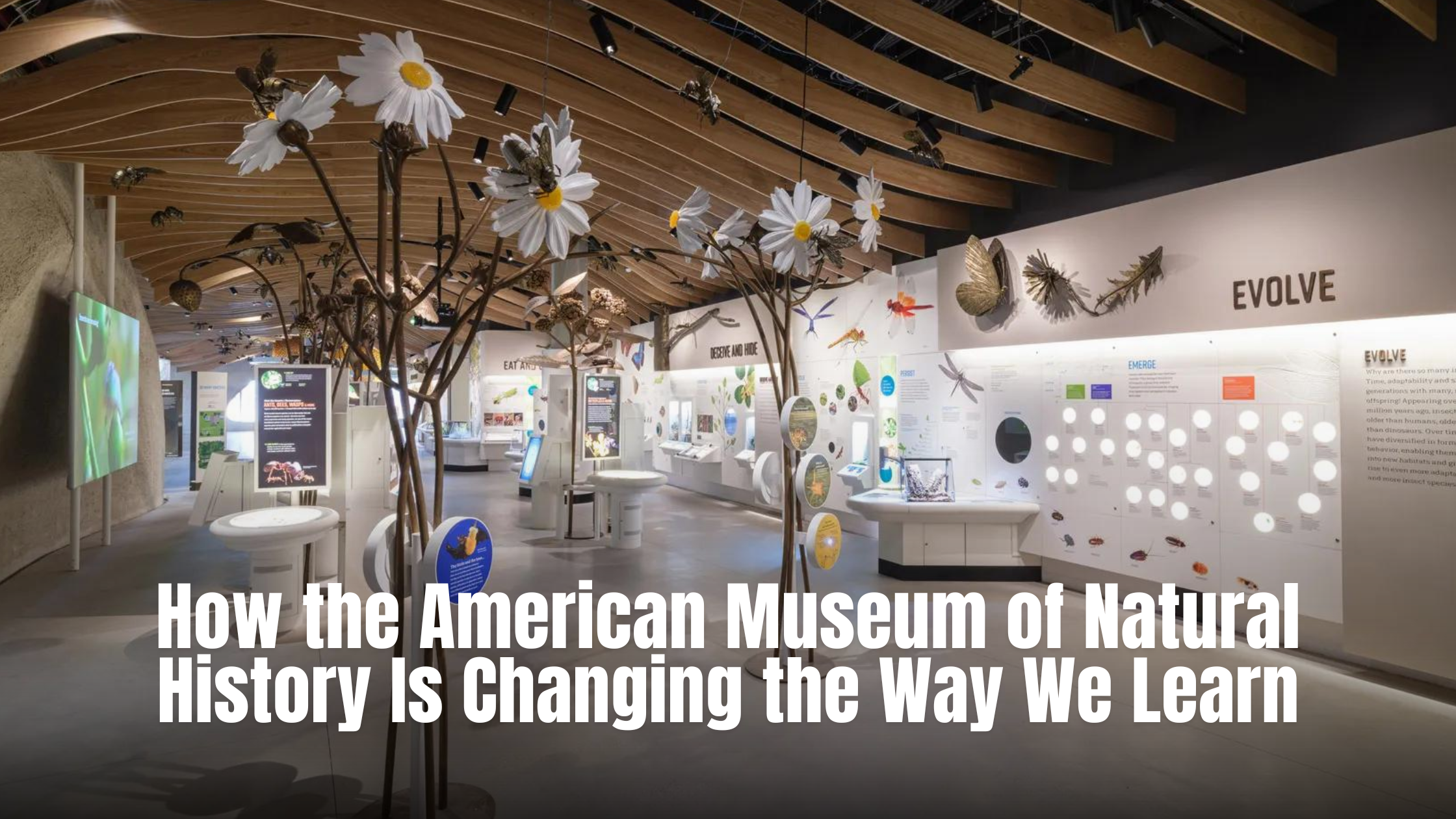
That’s one of the experiences that the Susan and Peter J. Solomon Family Insectarium at the American Museum of Natural History in New York sets out to create. Rather than simply displaying preserved specimens, the Insectarium invites visitors to look more closely at the world of insects through live exhibits, interactive installations, visual storytelling and hands-on experiences.
And perhaps this is where the future of museums is headed: towards helping us understand how things live, rather than simply showing us what exists.
The ant museum
In May 2023, the American Museum of Natural History in New York opened the Susan and Peter J. Solomon Family Insectarium. According to SEGD (Designers of Experiences), it is the museum’s first gallery dedicated to insects in more than 50 years.
The stars of the exhibit are the ants. The hall holds one of the world’s largest displays of live leafcutter ants, with a foraging area, a fungus garden and a transparent skybridge that visitors can walk under.
You are not simply looking at a preserved ant but standing below a working colony, watching these insects carry out their daily activities.
Why put ants at the centre of a museum?
Most of us simply swat or sweep ants away. The museum takes a different approach, asking us to take a moment to observe and appreciate nature’s beauty.
Scientists have described approximately 1.2 million insect species, but many more remain undiscovered. A 2026 study reported by the University of Colorado Boulder estimates that there could be between 14 million and 20 million insect species worldwide.
A museum that gives so much space to ants is making a cultural statement as much as a scientific one: the creatures we step over every day deserve our attention.
Beyond the glass case
This is where the idea of a “living exhibit” becomes interesting.
The hall has 18 displays of live insect species, a beehive model 25 times life-size that visitors can enter, and a role-play game called “Be a Bee”, where visitors take on different responsibilities within a hive.
A 12-foot-tall flower lets visitors activate a pollination sequence. Sliding magnifiers and microscopes allow them to study pinned specimens up close, while a sound gallery plays the sounds of insects found in Central Park.
The museum also maps insects across New York’s five boroughs, reminding city visitors that wildlife isn’t always somewhere far away. It can be in the park down the road or even in a corner of the kitchen.
Designed for everyone
According to SEGD’s account of the Insectarium’s design, the gallery relies more on photographs, infographics and other visual elements than many of the museum’s older halls. This approach is intended to engage younger visitors as well as people who may not be fluent in English.
The exhibit also includes touch models, sound-based experiences and magnifiers to support different learning styles and accessibility needs.
The design team wanted the space to feel wonderful, weird and a little creepy, while encouraging visitors to appreciate a group of animals that is often misunderstood.
Choosing interactive designs and images is perhaps one of the most interesting decisions in the hall. Visitors aren’t limited to reading information panels. They can observe, explore and participate in the learning experience.
Indian homes have understood this for generations
Interestingly, the idea of observing and making space for small creatures isn’t entirely unfamiliar to us.
In many South Indian homes, women traditionally draw kolam, intricate patterns made with rice flour, at the entrance or on the verandah. Apart from their cultural and artistic significance, these patterns have also been associated with feeding ants and other small creatures.
As this account of the kolam tradition explains, the practice has long reflected a relationship between everyday life, art and the natural world.
While a traditional kolam and a modern insect museum serve very different purposes, both offer an interesting reminder of how closely insects are connected to our surroundings.
Perhaps the real purpose of a museum is to make us look again
One of the most exciting things about the Insectarium is the way it asks visitors to reconsider something they might otherwise overlook.
We often treat insects with fear or irritation. But we sometimes forget how essential they are to ecosystems, serving as pollinators, decomposers, seed dispersers and soil aerators. The museum uses familiar creatures to introduce a much bigger ecological conversation.
A child who watches a leafcutter ant carry a piece of leaf across a transparent bridge may leave with more than a fun memory. They might begin questioning how colonies work, how insects communicate or why biodiversity matters.
An adult might walk away with a renewed appreciation for creatures they have spent years ignoring.
Museums don’t necessarily need more screens or enormous installations to remain relevant. What they need is to give people reasons to be curious, ask questions and engage with what they see.
Learning isn’t limited to books alone. Sometimes, it begins with stopping to watch an ant going about its everyday activities.