
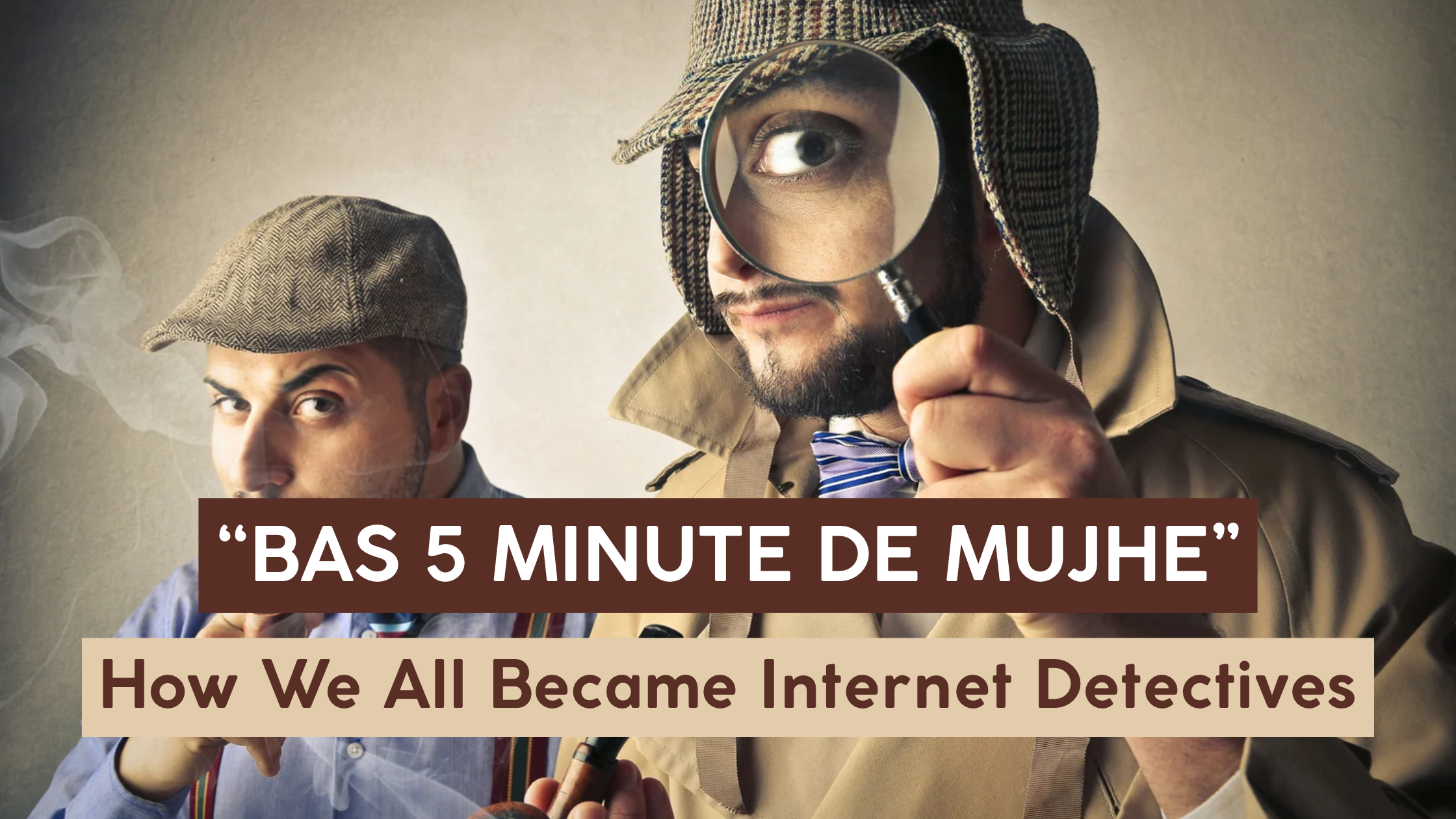
“Bas 5 Minute De Mujhe”: How We All Became Internet Detectives
“Kaun hai yeh ladka in the third photo?”
“Pata nahi, koi friend hoga.”
“Ruk. Do minute de.”
Forty minutes later…
“Naam Rohan hai, Pune se hai, ex ka naam Sneha tha, dog ka naam Bruno, aur 2019 mein ek bohot cringe poem post ki thi.”
If this sounds like you or someone you know, congratulations. You’re a fully certified Internet Detective. No degree, no licence, no formal training required. The internet simply handed you a magnifying glass and whispered, “Jaa beta, pata laga ke aa.”
But somewhere between harmless curiosity and scrolling through a stranger’s entire digital history, have we all become amateur surveillance experts?
Detective Degrees We Never Studied For
Ask someone with a smartphone to find out who a person is, and watch them become RAW, CBI and Sherlock rolled into one very determined aunty.
The internet has made the job remarkably easy. A reverse image search can sometimes trace a photograph to its original source. A username on one app might lead to five other profiles. A reflection in someone’s sunglasses, a signboard in the background, or even the tiles on a floor can suddenly become “evidence.”
And once you’ve found one clue, there’s always another waiting to be discovered.
The Reverse Image Search
That “Dubai-based businessman” in your friend’s DMs? A quick reverse image search reveals that his profile picture actually belongs to a Turkish model.
Kuch toh gadbad hai, Daya.
We’ve become that suspicious relative who squints at a photograph and says, “Yeh original nahi lag raha.” Except now, we have the tools to check whether our suspicions are right.
Of course, finding a photograph elsewhere doesn’t always prove someone is a scammer. But it can certainly give you a reason to ask questions.
Reddit, Location Spotting and the Deep Scroll
On platforms like Reddit, people sometimes come together to investigate an image, a mysterious location or an unexplained incident. A random clue leads to another, and soon strangers are comparing photographs and timestamps as though they’re working on an actual case.
Sometimes, all this detective work is directed at someone who simply posted a picture of their dosa.
Bhai, woh sirf breakfast kar raha tha.
Then there’s the geo-detective, who can identify a location from the tiniest detail.
“That’s not Goa. That’s definitely Pondicherry. Look at the café signboard.”
And finally, there’s the archaeological scroll. The person who can dig through years of someone’s social media history, find forgotten photographs, old comments and questionable captions, all without leaving a single accidental like.
Kyunki ek galti aur poori investigation barbaad.
What’s fascinating is how much information we can piece together from things people have voluntarily shared online. A photograph here, a tagged location there, an old username somewhere else. Individually, these details might seem insignificant. Together, they can reveal quite a lot about someone’s life.
Okay, But Is This Actually Harmless?
Sometimes, yes. Curiosity is natural, and checking whether someone is genuine before interacting with them can be sensible.
Verifying a potential date’s identity isn’t necessarily creepy. Our mothers were running background checks on rishtas long before Google existed. We’ve simply digitised the process.
But the same tools that help expose a fake profile can also be used to invade someone’s privacy.
There’s a difference between checking whether the person you’re speaking to is genuine and trying to uncover every detail about a stranger who annoyed you online.
And there’s another question worth asking: just because someone’s information is publicly available, does that mean we’re entitled to collect it, investigate it or share it with others?
A person’s digital footprint can reveal far more than they realise. Sometimes, we cross the line between curiosity and intrusion without even noticing.
In Conclusion, Jasoos Ji…
“Toh pata chala kuch us bande ke baare mein?”
“Haan. Sab kuch.”
“Toh ab kya karega is information ka?”
“…Kuch nahi. Bas curiosity thi.”
“…Beta, tu theek hai?”
The funny thing about internet detective work is how often it begins with a completely ordinary question and ends with us knowing far too much about someone we’ll probably never meet.
Maybe it’s curiosity. Maybe it’s caution. Sometimes, it’s simply the satisfaction of finding an answer.
So the next time you’re forty minutes deep into a stranger’s 2015 vacation album, ask yourself the one question every good jasoos should:
Bhai, tere paas itna time kaise hai?
And perhaps one more: Mujhe yeh sab jaanne ki zaroorat bhi hai?
Case closed.