

Mard Ko Dard Nahi Hota: The Cost of Teaching Men to Hide Pain
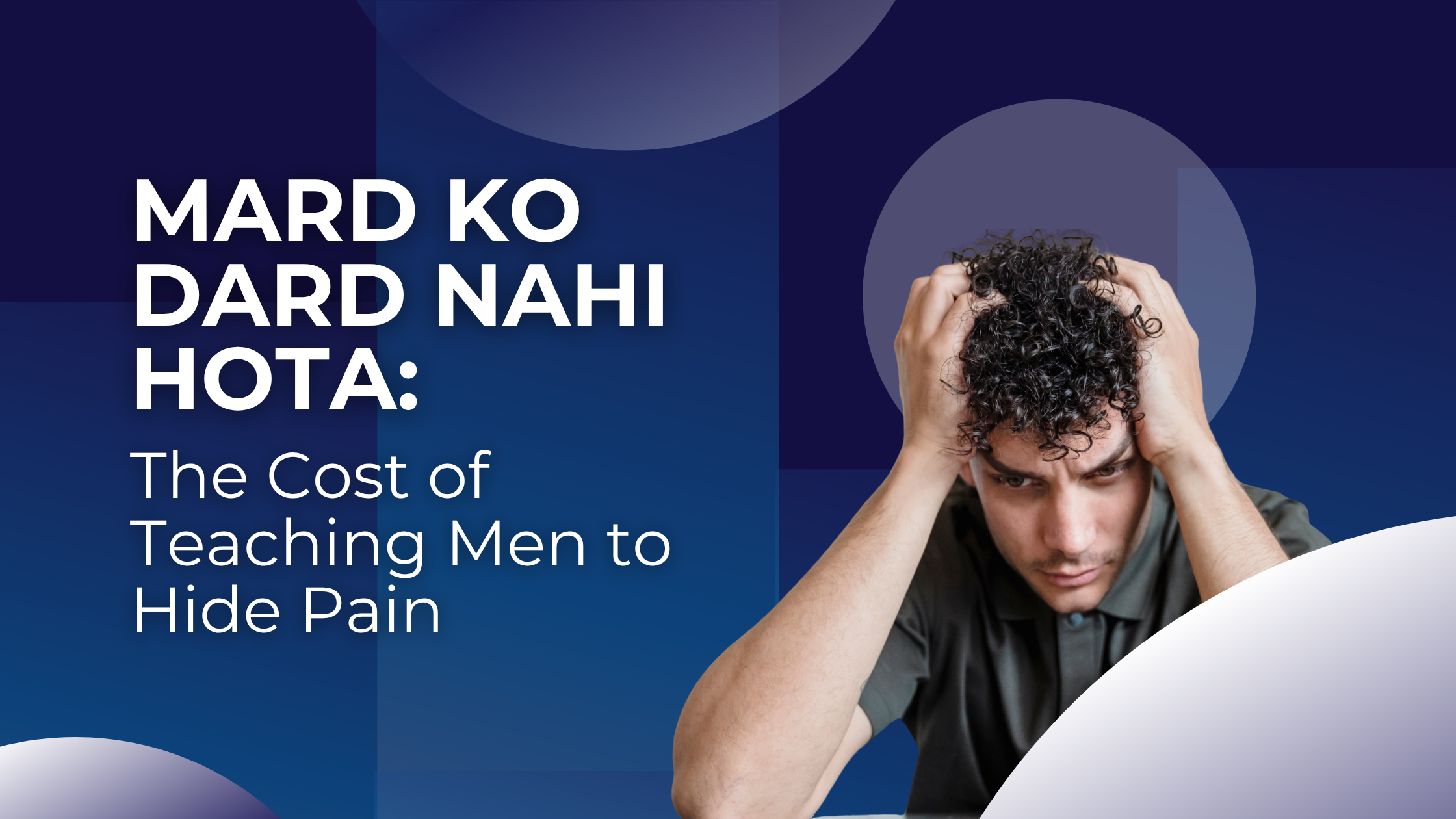
“Mard ko dard nahi hota.” Let’s admit it: we’ve all heard this before.
A boy hears some version of it before he is even old enough to understand what it means. He falls and cries, and someone tells him boys don’t cry. He is frightened, and they tell him to be brave. Don’t you think that is wrong on so many levels?
The poor guy is in pain. He is hurt, and yet he is being told to be strong. Why do we do this? Is there a reason, or are we unknowingly wiring this thought into him for a lifetime?
Gradually, over the years, he learns the lesson so well that by the time he becomes an adult, he may not even reach for the words anymore. He simply swallows it all.
This is how many Indian men are raised. It is not necessarily done cruelly. Often, it comes from people who love them. But somewhere along the way, they are taught a kind of silence that can last a lifetime. And sometimes, that silence comes at a devastating cost.
Where Does the Silence Begin?
It begins early, and very often, it begins at home. Usually with love, which is what makes it so hard to see.
A boy who has just scraped his knee is told to stop crying and “be a man” or “be strong.” A boy who is frightened may be gently mocked for being soft. Meanwhile, feelings such as fear, sadness and tenderness get labelled as weakness, while toughness and stoicism are praised.
Researchers have described this as “restrictive emotionality”, where men learn to restrict or avoid expressing certain emotions. The boy is not necessarily taught that emotions themselves are bad. He is taught that showing them is.
So he slowly learns to hide them.
By adulthood, this habit can become deeply ingrained. Anger may be easier to express because anger is often seen as more acceptable in men. But sadness, loneliness, fear or shame can become far harder to put into words, especially for someone who was never encouraged to talk about them in the first place.
What Do We Actually Take Away From Men When We Do This?
We take away something very basic: the permission to feel without being embarrassed by it.
Think about it. Where is a man comfortably allowed to be soft?
At work, there is pressure to appear capable and in control. With parents, he may not want to worry them. Among male friends, vulnerability can sometimes turn into teasing instead of comfort. Even with a partner, some men struggle to let go of the idea that they have to be the strong one or the person who holds everything together.
None of this means every man experiences relationships in the same way. But for someone who has spent years hiding difficult emotions, the circle of people he feels comfortable opening up to can become very small.
He can be surrounded by people and still feel completely alone with what he is carrying.
That is the quiet tragedy. It is not that men do not have emotions. It is that many grow up without knowing where those emotions are supposed to go.
How Is This Silence Affecting Men?
When people are taught not to talk about pain, that pain does not simply disappear. It can sometimes show up in other ways, through anger, overwork, withdrawal or unhealthy coping mechanisms such as alcohol.
The numbers make the conversation difficult to ignore.
According to the National Crime Records Bureau’s 2023 Accidental Deaths and Suicides in India report, 171,418 suicides were recorded in the country that year. Men accounted for 72.8% of them, while women accounted for 27.2%.
India also continues to have a large mental health treatment gap. The National Mental Health Survey conducted by NIMHANS in 2015–16 found that the treatment gap for different mental disorders ranged from around 70% to 92%.
There are many reasons behind suicide, and no single statistic can explain why someone reaches that point. Financial difficulties, family problems, relationships, illness and mental health concerns can all play a role. What we do know is that being unable or unwilling to seek support can make an already difficult situation even harder.
This is not a competition of pain between men and women. Women face their own enormous social pressures and mental health struggles. But when boys repeatedly grow up hearing that showing pain makes them weak, we also need to ask what that lesson does to them when they become men.
Why Do Men Find It So Hard to Ask for Help?
For many men, asking for help can feel like admitting weakness, and weakness is exactly what they may have spent years learning to hide.
There is the fear of being judged. There is log kya kahenge. There may be worries about being taken less seriously at work or appearing weak in front of family and friends.
Then there is something even simpler: lack of practice.
Someone who was never encouraged to name his feelings as a boy may genuinely struggle to find those words at thirty-five while sitting across from a friend, a partner or a therapist.
Social media can add another layer to this. We constantly see people who appear successful, confident and completely in control. Male vulnerability can still become a joke online, reinforcing the same message many boys heard growing up: keep it to yourself.
From “Log Kya Kahenge” to “It’s Okay to Not Be Okay”
Thankfully, that conversation is beginning to change.
Therapy and mental health are being spoken about far more openly than they once were. Male actors, athletes and public figures have spoken publicly about depression, anxiety and the pressure to appear strong. Some parents are also consciously choosing different words with their sons.
“It’s okay to be scared.”
“It’s okay to cry.”
“You can tell me when something is wrong.”
These may sound like simple sentences, but they challenge something boys have heard for generations.
That is also what conversations around suicide prevention need to do. Statistics tell us the scale of the problem, but prevention also happens in ordinary moments. It happens when somebody feels safe enough to admit that things are not okay and knows that the person listening will take them seriously.
What Can We Actually Do?
- When a man says “I’m fine” but clearly does not seem fine, ask again. Sometimes, “No, really, how are you?” is what opens the conversation.
- Do not tease someone for crying, being afraid or showing vulnerability.
- Let boys cry without immediately telling them to toughen up.
- Talk about therapy and mental healthcare as normally as you would talk about seeing a doctor for physical health.
- Check in on the person who always seems to be holding everyone else together. He may need somebody to hold space for him too.
Perhaps we need to stop teaching boys that strength means feeling nothing.
A man should be able to say that he is scared, overwhelmed, lonely or simply not doing okay without feeling that he has somehow failed at being a man.
And when he does say it, maybe the best thing we can do is listen.
If you or someone you know is struggling, support is available. Tele-MANAS, the Government of India’s 24×7 tele-mental health service, can be reached at 14416 or 1800-89-14416.