

Jeffrey Archer Wrote Plot Twists for a Living. His Own Life Had More Than Most of His Novels
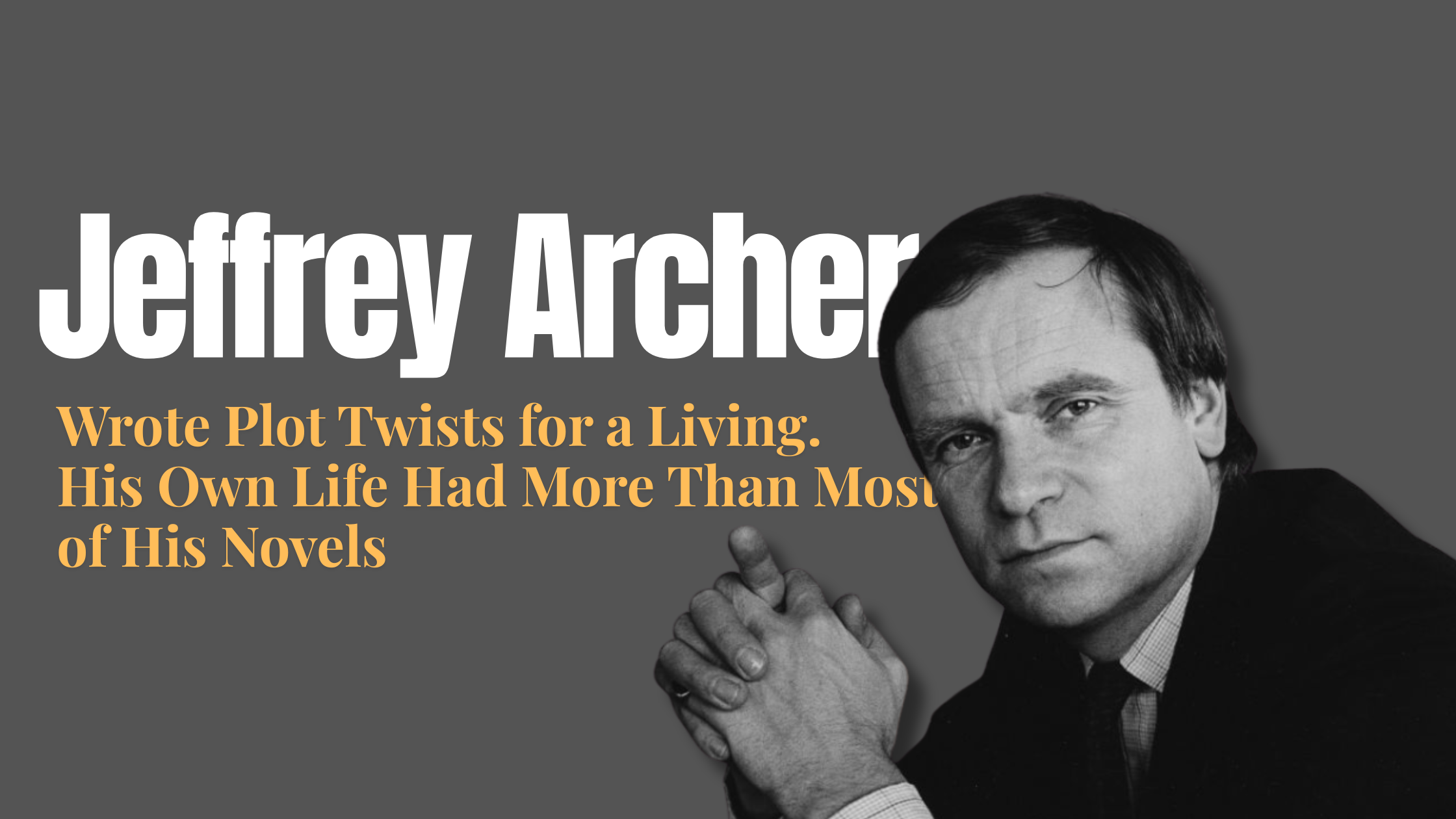
Jeffrey Archer died on 5 October 2026 at the age of 86, a day before his final novel Adam & Eve was due to be published. By then, he had sold more than 300 million books worldwide and built a public life almost as eventful as the stories he wrote.
Archer had been a member of Parliament, faced financial ruin, rebuilt his career as a bestselling novelist, returned to politics, won a major libel case and was later sent to prison for lying during that same trial.
He was known for writing about ambition, deception, power, reversals and unlikely comebacks. Knowing what happened outside his books makes it difficult not to read some of that biography back into the fiction.
From Parliament to financial ruin
Archer was elected Conservative MP for Louth in 1969 at the age of 29 and remained in the House of Commons until 1974. He invested heavily in a Canadian company called Aquablast, which later went into liquidation and left him with debts of £427,727. On the brink of bankruptcy, he resigned from Parliament.
It was an unexpected turn that eventually pushed him towards writing. At 34, determined to repay his creditors, Archer wrote his first novel, Not a Penny More, Not a Penny Less. The financial crisis ended his first stint in Parliament and helped begin the writing career that would make him famous.
He would eventually become the only author to have reached No. 1 on the bestseller lists in fiction 19 times, short stories four times and non-fiction once.
The scandal that changed his public image
Archer later returned to politics and served as Deputy Chairman of the Conservative Party from September 1985 to November 1986.
In 1986, the Daily Star published allegations that Archer had paid Monica Coghlan for sex. Archer sued the newspaper and won the libel case the following year, receiving £500,000 in damages.
More than a decade later, the case returned to haunt him.
In November 1999, Archer withdrew from the race for Mayor of London after allegations emerged that he had fabricated evidence during the original libel trial. In July 2001, he was found guilty of perjury and perverting the course of justice. He was sentenced to four years in prison and released in July 2003 after serving two.
His time behind bars later became A Prison Diary, a three-volume account based on his experiences in three different prisons.
The conviction did not remove Archer from public life altogether. He remained a member of the House of Lords until his retirement in 2024.
When an author’s biography follows you onto the page
Archer’s books are filled with complex schemes, intense rivalries, revenge and last-minute reversals. Once you know his biography, it becomes difficult not to notice the overlap: ambitious people, carefully constructed plans, reversals of fortune and characters trying to recover after everything goes wrong.
The words on the page do not change, but the reader does. Biography brings opinions, sympathies and suspicions into the reading experience, whether we intend it to or not.
With Archer, that connection is especially difficult to ignore because so much of his public life involved the same things that kept appearing in his fiction: ambition, power, downfall and comeback.
Can you separate the book from the person who wrote it?
Some readers separate the two completely and treat an author’s life as something outside the book. Others find that impossible once they know enough about the person behind the work. And some stop reading when an author’s conduct changes how they feel about supporting the work.
The more interesting question is where the change actually comes from. Does the book feel different because of the writing, or because of what we now know about the writer?
With Archer, it is probably a bit of both.
His books were fast, dramatic and built to make readers turn one more page. Millions did, for five decades. He died a day before the publication of Adam & Eve, the novel intended to close his writing career. It was an ending with the kind of timing even Archer might have found difficult to invent.
Whatever you make of Jeffrey Archer, separating the writer from the very public life around him was never going to be simple.