

Remembering Nana Patekar: The Actor Who Never Fit Bollywood’s Hero Mould
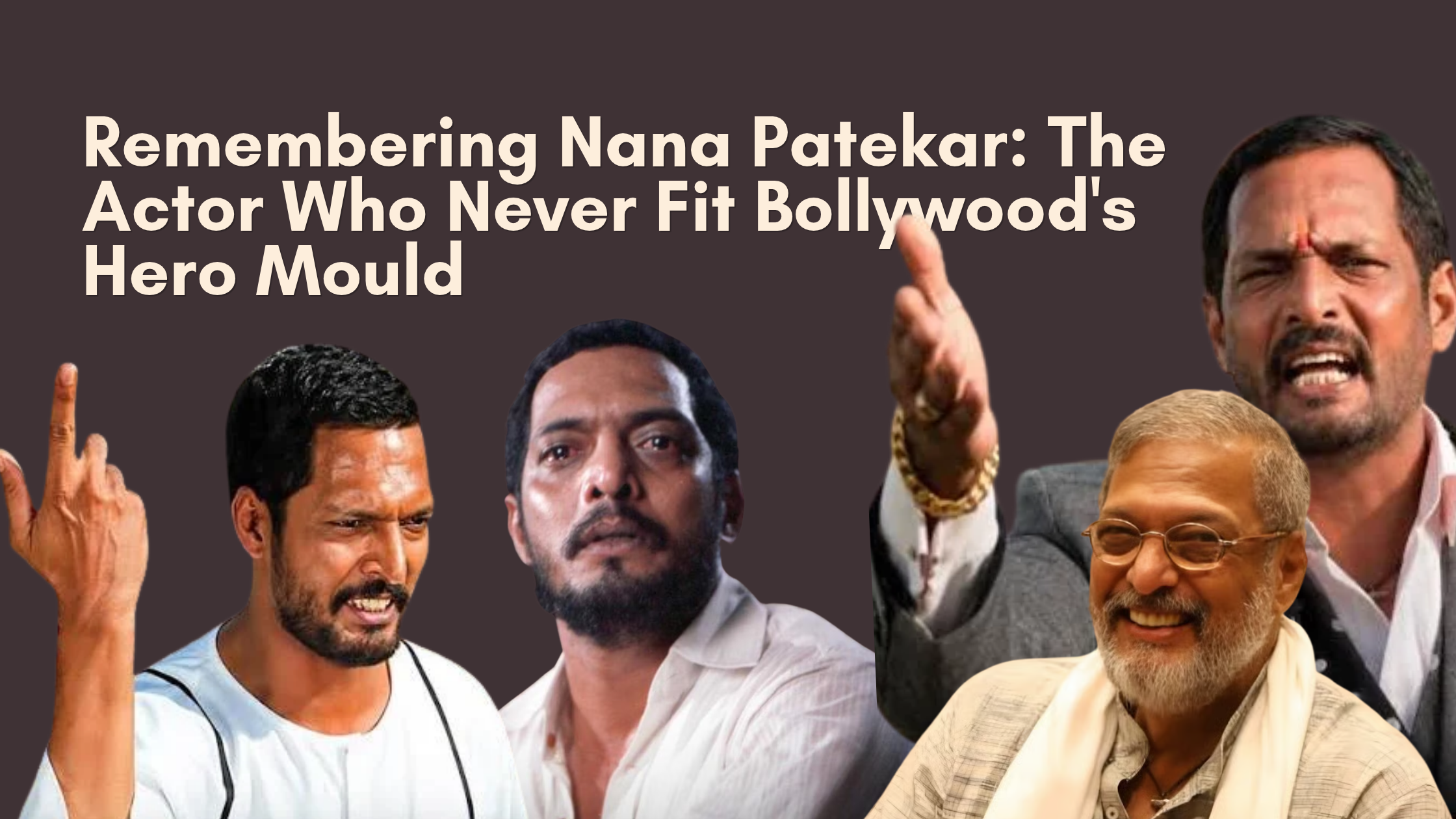
From the terrifying Anna in Parinda to the hilarious Uday Shetty in Welcome, Nana Patekar gave Indian cinema characters that audiences could love, hate, fear and laugh at.
Nana Patekar, one of Indian cinema’s most recognisable actors, passed away on October 8, 2026, at the age of 75, following a reported cardiac arrest at his residence in Goa. Over a career spanning nearly five decades, he worked across Hindi and Marathi cinema, playing gangsters, angry idealists, troubled husbands and ageing artists. He won three National Film Awards and received the Padma Shri in 2013, building a career that rarely followed Bollywood’s conventional idea of stardom.
Bollywood has always had a certain idea of what a hero should look like. Good looks, romantic songs, dramatic action sequences and the ability to charm an audience have traditionally been part of the package. Nana Patekar didn’t fit that description, and he never seemed particularly interested in trying.
He had an unmistakable voice, an unusual style of dialogue delivery and a screen presence that could make an ordinary conversation feel threatening. He could turn a simple exchange into an argument, make silence uncomfortable and leave audiences wondering what his character might do next.
Yet the same actor who became famous for playing frightening and volatile men would eventually make audiences laugh as one of Bollywood’s most ridiculous gangsters.
When the villain was more interesting than the hero
In Vidhu Vinod Chopra’s Parinda (1989), Patekar played Anna, a ruthless gangster whose unpredictable behaviour made him genuinely frightening. He could appear calm one moment and become violently aggressive the next. His performance earned him the National Film Award for Best Supporting Actor and remains one of the film’s strongest elements.
At a time when Bollywood villains were often recognised by their elaborate entrances, costumes and dramatic dialogues, Anna was disturbing because his reactions were so difficult to anticipate.
Patekar understood the effect of a well-timed pause. He could speak rapidly, almost as though he was struggling to contain his anger, before suddenly falling silent. His expressions often revealed what his character was thinking before he said anything.
In Krantiveer (1994), that intensity found a different purpose. Playing Pratap Narayan Tilak, he delivered angry speeches against corruption, injustice and communal divisions. The film’s dialogues became enormously popular, and Patekar won the National Film Award for Best Actor.
Anger became closely associated with his performances, although he used it differently across films. In Agni Sakshi, he played an obsessive and controlling husband whose behaviour was deeply disturbing. In Ab Tak Chhappan, he portrayed an encounter specialist with an unsettling sense of composure.
Then there was Khamoshi: The Musical, where he played a deaf father. The role relied heavily on gestures, expressions and body language, showing how effectively he could communicate without the voice audiences had come to associate with him.
His experience in theatre was evident in the way he approached these characters. He could be loud and theatrical when the role demanded it, but he also knew when to hold back.
Then came Uday Shetty
When Welcome released in 2007, audiences discovered a completely different side of Nana Patekar.
He played Uday Shetty, a gangster desperately trying to arrange his sister’s marriage into a respectable family. Alongside Anil Kapoor’s Majnu Bhai, he created one of Hindi cinema’s funniest comic partnerships.
Uday was short-tempered, easily offended and convinced that everyone should take him seriously. Unfortunately for him, most situations he found himself in were increasingly ridiculous.
What made the character funny was how seriously Patekar played him. Uday genuinely believed he was an intimidating man, even when his attempts to control a situation ended in complete embarrassment. His frustration, expressions and arguments became the source of much of the film’s humour.
Almost two decades later, scenes from Welcome continue to circulate through memes and reaction videos. Uday Shetty’s expressions have become familiar even to people who may never have watched the entire film.
For audiences who grew up watching Parinda and Krantiveer, Patekar was the actor who could make a room go silent. For younger viewers, he was the gangster who couldn’t organise his sister’s wedding without creating absolute chaos.
The fact that both characters were played by the same actor says plenty about his range.
The kind of actor Bollywood once made room for
Patekar’s career also offers an interesting look at Hindi cinema during the 1980s and 1990s, when actors could become major names without necessarily resembling conventional leading men.
He worked in mainstream entertainers, crime dramas and films dealing with social issues. He could play the protagonist, antagonist or supporting character, depending on what the story demanded.
His work in Marathi cinema was equally significant.
In Natsamrat (2016), he played Ganpat Ramchandra Belwalkar, a retired theatre actor struggling with ageing, family relationships and the loss of his former life. The character had spent years receiving applause on stage but found it difficult to adjust to a world where he was no longer the centre of attention.
It was an emotionally demanding role that allowed Patekar to explore vulnerability and helplessness, emotions that were often overshadowed by the anger associated with his Hindi film characters.
Natsamrat also demonstrated how regional cinema could offer established actors substantial roles that mainstream Bollywood did not always provide.
His career, however, was not without controversy. In 2018, actor Tanushree Dutta accused him of sexual harassment during the filming of Horn ‘Ok’ Pleassss in 2008. Patekar denied the allegations, and Mumbai Police later filed a closure report citing insufficient evidence. The allegations became part of the wider discussion around India’s #MeToo movement.
Any examination of his public life must acknowledge these allegations alongside his work. An actor’s contribution to cinema can be recognised without overlooking the controversies surrounding him.
The characters that outlived their films
One of the more interesting things about Nana Patekar’s career is how his characters have remained familiar to audiences who discovered his work decades apart.
His speeches from Krantiveer are still remembered for their forceful delivery. Parinda remains an important film in discussions about Hindi cinema’s gangster dramas. Uday Shetty continues to appear in internet memes, while Natsamrat holds a special place among audiences of Marathi cinema.
There are actors whose popularity depends heavily on their image as stars. Patekar’s appeal was often tied to the characters themselves, many of whom were flawed, unpleasant or difficult to understand.
He also belonged to a generation when audiences were willing to accept leading men who didn’t necessarily look or behave like heroes. His career was proof that an unusual voice, a commanding presence and a willingness to play difficult characters could be enough to hold an audience’s attention.
Indian cinema has changed considerably since Patekar first appeared on screen in Gaman in 1978. The films audiences watch, the actors they celebrate and even the way performances become popular have changed.
But his characters continue to find their way into conversations, television reruns and social media feeds.
Someone who knows Nana Patekar only as Uday Shetty might watch Parinda for the first time and struggle to believe that the same man played Anna. Someone familiar with his angry speeches might discover the quieter, more vulnerable performance in Natsamrat.
For an actor who spent nearly five decades refusing to be confined to one kind of role, perhaps there is no better way to be remembered.