
A Boy Who Cannot Speak Is Chosen as a Storyteller: The Idea at the Heart of Giants
What makes someone a storyteller?
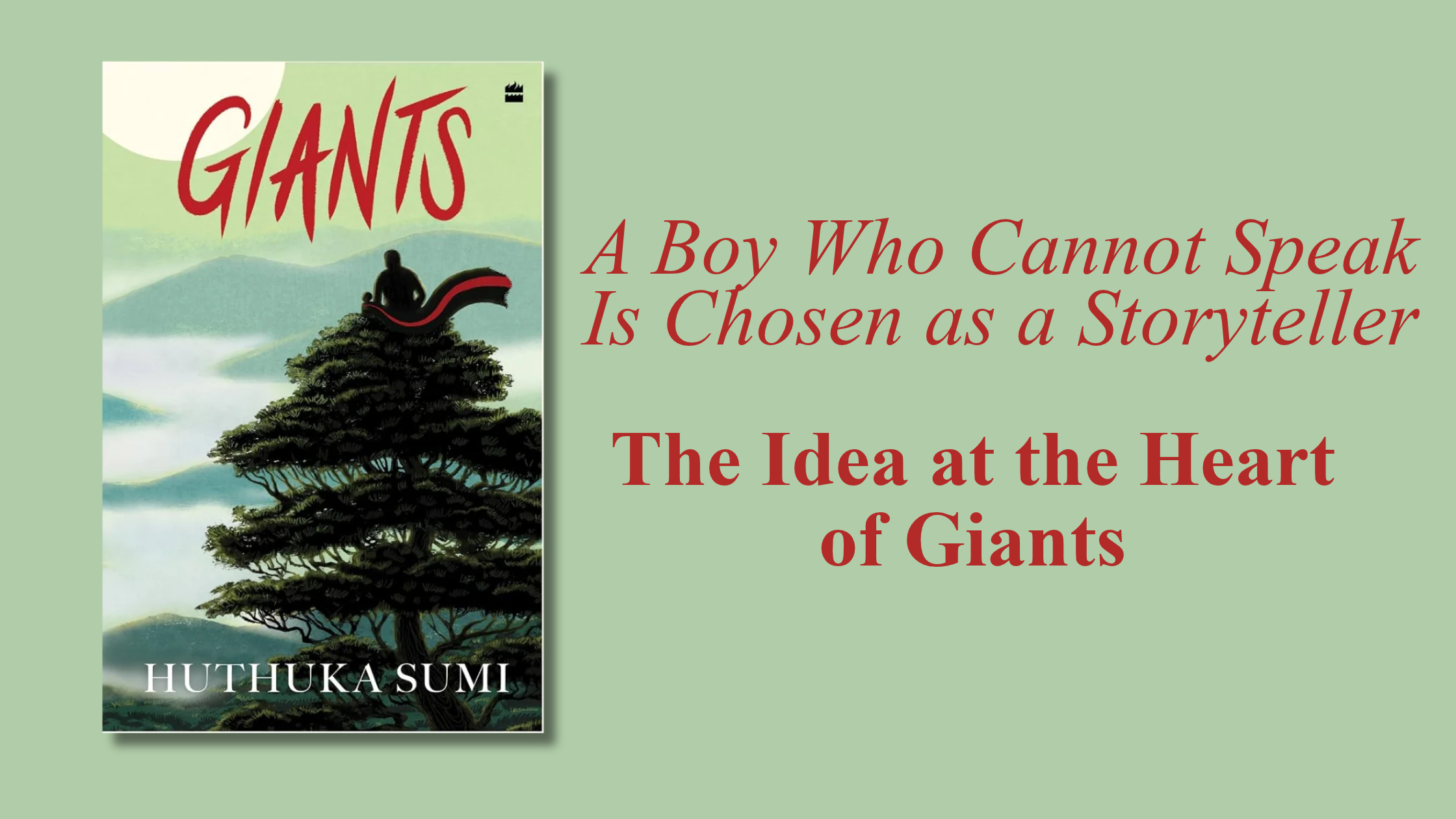
In Huthuka Sumi’s Giants, published by HarperCollins India in 2025, that question is given to Kato, a 12-year-old boy who cannot speak. He lives in the fictional mountain village of Ayito-phu in Nagaland, surrounded by family, farming, stories and a world beginning to change. When Kene, one of the mythical Old Ones, appears looking for someone to carry their stories forward, he chooses Kato.
Kato’s reaction is immediate: how can someone who cannot speak become a storyteller?
That question sits at the heart of the book. It separates speech from voice, and storytelling from simply being able to talk.
What does it mean to have a voice without speaking?
Kato wants what many people around him take for granted: the ability to speak.
His silence shapes how others see him. He is bullied at school and made to feel that something essential is missing. Yet when Kene chooses him as a storyteller, the quality that appears to exclude him from that role becomes part of what makes him suited to it.
The premise of Giants asks Kato to discover what having a voice actually means as the world around him begins to change.
The distinction is important. Speaking is one form of communication, but storytelling also depends on attention, memory, interpretation and the ability to notice what others overlook.
Kato listens.
People tell him things. He watches the village around him. He absorbs the stories passed down by his mother and his friend Apu. His role is not built around speaking louder than everyone else, but around remembering what could otherwise disappear.
Why is Kato chosen to carry stories?
The choice becomes more meaningful when placed against the changes happening around Ayito-phu.
The novel is set in a period when colonial presence, war and new institutions are beginning to alter village life. Kato is tasked with preserving the memories of the Old Ones as their world approaches extinction.
That turns storytelling into something larger than entertainment.
Stories become a way of holding on to memory.
A myth, a family story or a village legend can carry knowledge about how people understand the land, danger, relationships and themselves. Once those stories disappear, something about the community disappears with them.
Kato is therefore chosen not simply to repeat stories, but to carry them.
How does Giants draw from Sumi Naga storytelling traditions?
The world of Giants is rooted in the cultural landscape of Nagaland.
Sumi wanted to avoid turning Sumi culture into an “anthropological exercise”, keeping the cultural details inside the story rather than explaining them for an outsider.
The novel includes local language, jhum cultivation, food, myths and stories about beings such as the timi-la, giants associated with protecting humans in the forests. Kato’s mother is one of the people through whom these stories reach him.
This matters because oral storytelling has long been central to many Naga communities. Stories can carry history, belief and social memory without first needing to exist in written form.
Giants brings that tradition into a written novel while keeping storytelling itself central to the plot.
What happens when a community’s stories begin to disappear?
Sumi has described the book as being concerned with change and the decisions that change forces people to make.
Kato’s journey is also tied to a wider question around who will tell Naga stories, and in whose voice.
That gives his role another dimension.
He is growing up at a moment when the village is changing through colonial contact, war, schooling and outside influence. The question of who remembers the old stories is therefore also a question about what survives when a community changes.
This is where the mythical and historical parts of the novel meet. Kene may be a giant, but the task he gives Kato is very real: remember.
Huthuka Sumi and the world behind Giants
Giants is Huthuka Sumi’s debut novel.
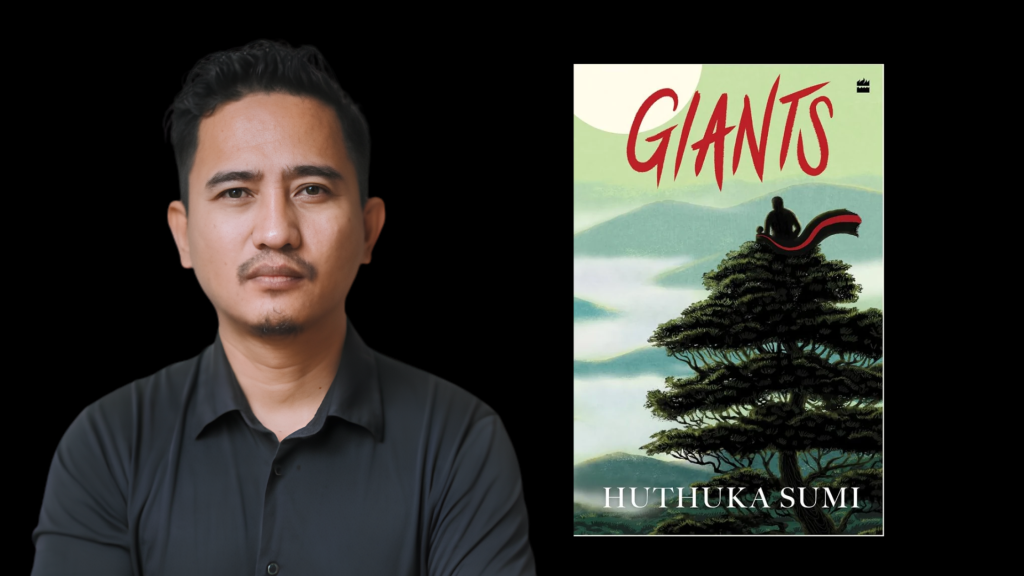
Sumi is a writer and photographer based in Dimapur, Nagaland. His earlier photography also focused on how Nagaland is represented. His 2011 exhibition O! Dimapur! looked at urban Nagaland and pushed back against images that reduced Naga life to something exotic or primitive.
That concern appears again in the way he has spoken about Giants. His work engages with identity, voice and tribal expression alongside questions of representation.
The book is illustrated by Canato Jimo, a picture-book maker and art director from Nagaland.
Giants won the 2025 Atta Galatta-Bangalore Literature Festival Book Prize for Best Book in Children’s Fiction, with the award recognising its use of Sumi Naga folklore, language, culture and traditions through Kato’s story.
In 2026, it also won the Valley of Words Book Award for Writing for Young Adults.
Who gets to carry a community’s stories?
Kato being unable to speak is not a twist to be solved. It is what makes the central question of Giants possible.
If storytelling depended only on speech, Kato would appear to be the wrong choice.
But stories also need listeners, witnesses and people willing to remember.
That is where the premise becomes larger than one boy. Communities do not preserve memory simply by having stories. Someone has to carry them forward.
Read Giants with us
Giants is one of the 12 titles on our Blogchatter Book List 2026 Longlist.
From the many books recommended by readers, authors and publishers, 12 made the Longlist. If you pick this one, leave your review on its book listing on the Blogchatter website once you finish reading.
We’re also hosting a lucky draw for readers exploring the Longlist:
Read 1–5 books: 5 winners receive 300 Reward Points each
Read 6–12 books: 5 winners receive 500 Reward Points each
A review on the book’s Blogchatter listing is required for eligibility. Blogs, reels, Stories and other content are welcome, but optional.
You have until 30 November to read and review. More details about voting will be shared towards the end of the month.
About the author
Huthuka Sumi is a writer and photographer based in Dimapur, Nagaland. His work engages with identity, memory, representation and indigenous storytelling. Giants, published by HarperCollins India, is his debut novel and has won the 2025 Atta Galatta-Bangalore Literature Festival Book Prize for Best Book in Children’s Fiction and the 2026 Valley of Words Book Award for Writing for Young Adults.
Note: We introduced the Blogchatter Book List in 2025 when the JCB Prize for Literature was discontinued. The Blogchatter Book List is our own reader-led initiative built around community recommendations, reading, reviews and voting.