
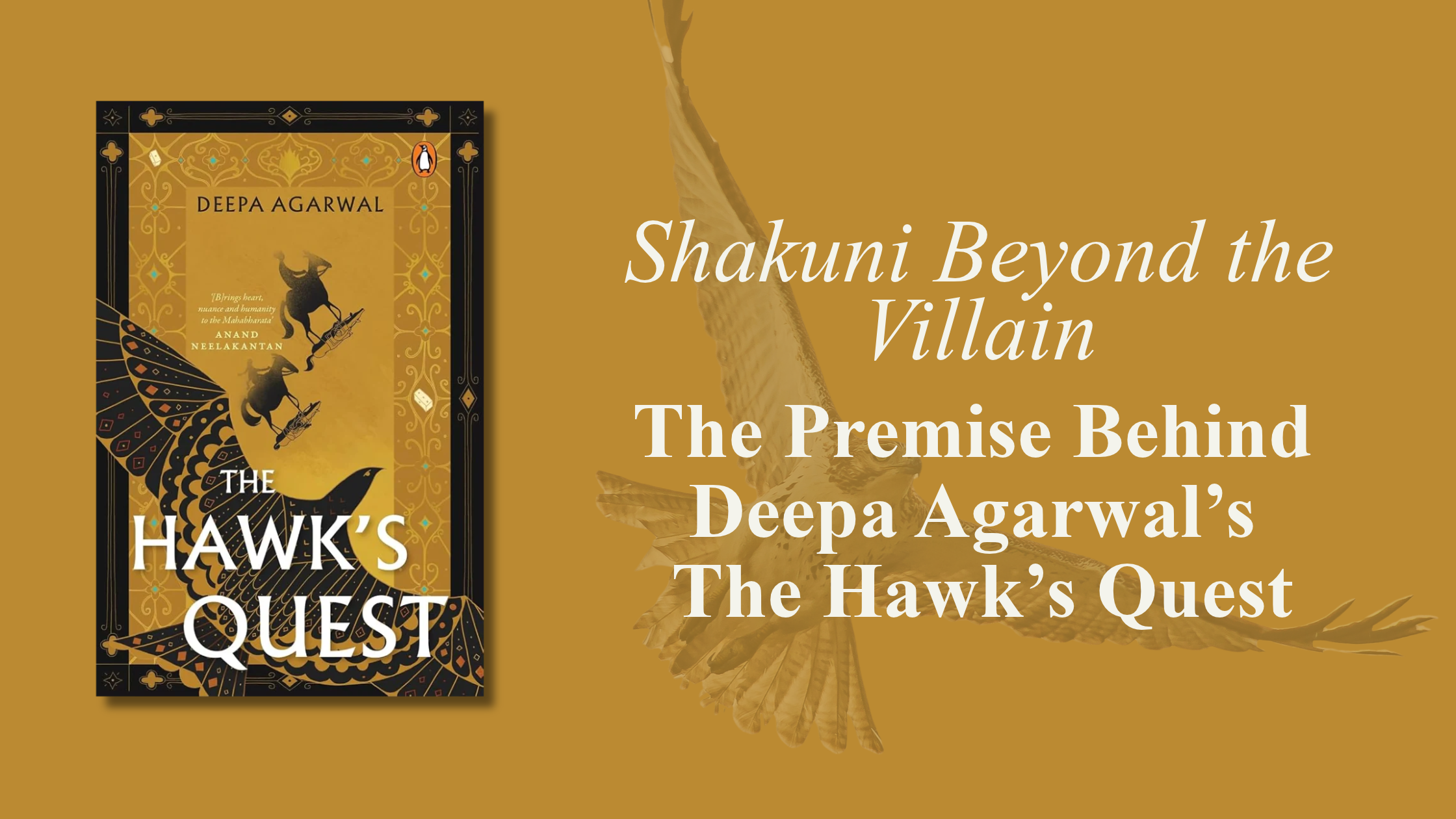
Shakuni Beyond the Villain: The Premise Behind Deepa Agarwal’s The Hawk’s Quest
Shakuni is one of those Mahabharata figures most people meet with a reputation already attached to him. He is remembered for manipulation, for influencing Duryodhana and for the game of dice that helped set the war in motion.
Deepa Agarwal’s The Hawk’s Quest, published by Penguin Random House India in 2026, begins from a different question: what if we look at the life around those actions instead of starting with the verdict?
The retelling follows Shakuni as king, brother, son, husband and father, placing his familiar role as strategist inside a larger story of family, loss and revenge.
Why does literature keep returning to characters remembered as villains?
Myths survive partly because every generation finds new questions to ask of them.
Some characters remain strongly associated with a single action. Ravana becomes the abductor. Kaikeyi becomes the queen who sent Rama into exile. Shakuni becomes the schemer behind the dice game.
Retellings can loosen those fixed roles.
That does not mean turning a villain into a hero. Often, the more interesting shift is simply from judgment to perspective. What happened before the action everyone remembers? What loyalties were involved? What did the character believe they were protecting or avenging?
The Hawk’s Quest takes that route with Shakuni. His actions remain central to the story, but the novel looks at the relationships and experiences that precede them.
The question changes from “Was Shakuni a villain?” to “What made revenge become the organising force of his life?”
Where does Shakuni’s revenge come from in this retelling?
The novel draws on a strand of folklore surrounding Shakuni rather than treating every part of his backstory as something stated in the Mahabharata itself.
In this version, Shakuni’s father, King Subala, and his ninety-nine brothers are condemned to die of starvation by Dhritarashtra. Before his death, Subala asks Shakuni to avenge the family and destroy the Kuru clan.
That vow gives the story its central motive.
It also changes how the familiar Shakuni can be approached. The strategist who later manipulates events in Hastinapur is presented as someone carrying a family grievance that has become inseparable from his political choices.
Understanding the motive does not require agreeing with what follows.
That distinction is useful in retellings. A character can become more comprehensible without becoming innocent.
What changes when Shakuni is also a brother, husband and father?
Villain labels tend to flatten characters.
Once somebody becomes associated with betrayal or cruelty, their other relationships often disappear from memory. The Hawk’s Quest deliberately brings those relationships back.
Shakuni is not only the uncle advising Duryodhana. He is also Gandhari’s brother, Subala’s son, a ruler of Gandhara, a husband and a father.
Looking at those roles changes the scale of the story. Political decisions are also family decisions. Loyalty to one person can become hostility towards another. Revenge is no longer abstract when it is tied to parents, siblings and lineage.
This is where mythological retellings can create space without rewriting the ending everyone already knows. The broad events may remain familiar, but the route into them changes depending on whose experiences are placed at the centre.
Why does perspective matter so much in mythological retellings?
A long-lived epic contains many characters, but not all of them receive the same amount of attention.
Retellings often begin in those gaps.
A writer can take a figure who has traditionally entered the story through someone else’s conflict and ask what that world looked like from their side. The result may complicate a familiar episode without claiming that earlier versions were wrong.
With Shakuni, the dice game and the Kuru-Pandava conflict are already part of popular memory. The Hawk’s Quest instead spends time in Gandhara and with the family history that the novel uses to explain his vow of revenge.
That shift matters because motive changes the way an action is read, even when the action itself remains the same.
It also allows readers to separate two questions that are often collapsed into one: why did someone do something, and was what they did justified?
Those answers do not have to be identical.
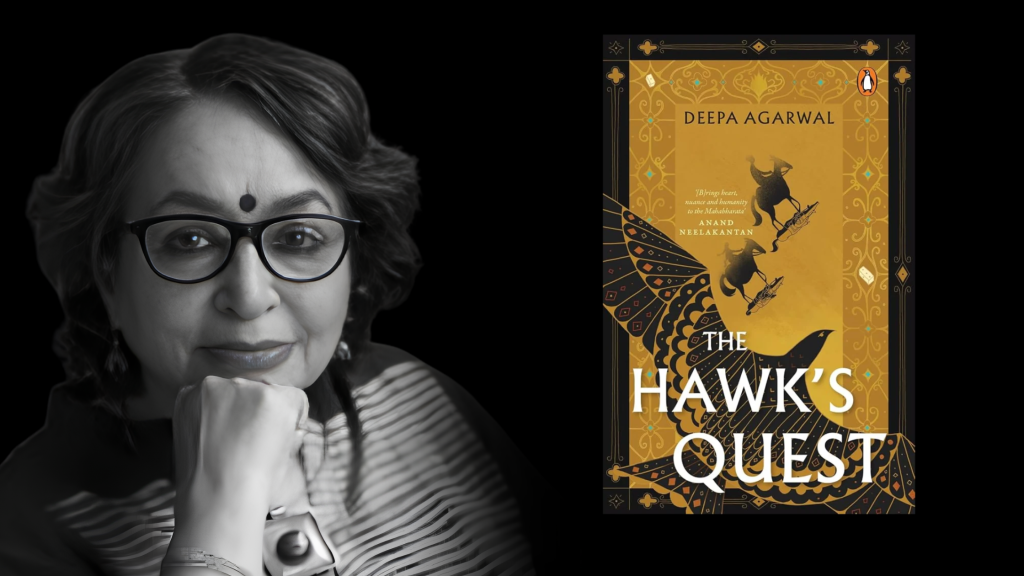
Deepa Agarwal has spent decades moving between myth, history and children’s literature
Deepa Agarwal’s work makes her a natural fit for this kind of retelling.
She has published more than sixty books for children and adults in English and Hindi, working across fiction, poetry, biography, historical fiction, folktales and mythology. Her books include Caravan to Tibet, The Arthashastra for Children, The Begum and Journey to the Forbidden City.
Her historical novel Caravan to Tibet was selected for the IBBY Honour List in 2008, while Ashok’s New Friends received the NCERT National Award for Children’s Literature. Her work has also appeared in several Indian and international languages.
Agarwal has spent a large part of her writing career revisiting history, legends and older stories for contemporary readers, retelling Indian folktales, legends and myths alongside creating original fiction.
The Hawk’s Quest extends that body of work into a full-length Mahabharata retelling centred on one of the epic’s most negatively remembered figures.
Read The Hawk’s Quest with us
The Hawk’s Quest is one of the 12 titles on our Blogchatter Book List 2026 Longlist.
From the many books recommended by readers, authors and publishers, 12 made the Longlist. If you pick this one, leave your review on its book listing on the Blogchatter website once you finish reading.
We’re also hosting a lucky draw for readers exploring the Longlist:
Read 1–5 books: 5 winners receive 300 Reward Points each
Read 6–12 books: 5 winners receive 500 Reward Points each
A review on the book’s Blogchatter listing is required for eligibility. Blogs, reels, Stories and other content are welcome, but optional.
You have until 30 November to read and review. More details about voting will be shared towards the end of the month.
About the author
Deepa Agarwal is an author, poet and translator based in Delhi. She has written more than sixty books for children and adults across fiction, poetry, mythology, historical fiction, biography and folklore. Her work has been translated into several Indian and international languages. Her notable titles include Caravan to Tibet, The Arthashastra for Children, The Begum and Journey to the Forbidden City.
Note: We introduced the Blogchatter Book List in 2025 when the JCB Prize for Literature was discontinued. The Blogchatter Book List is our own reader-led initiative built around community recommendations, reading, reviews and voting.