
32,490 Trees and a Question: What Else Could Be Lost Near Bhimashankar?
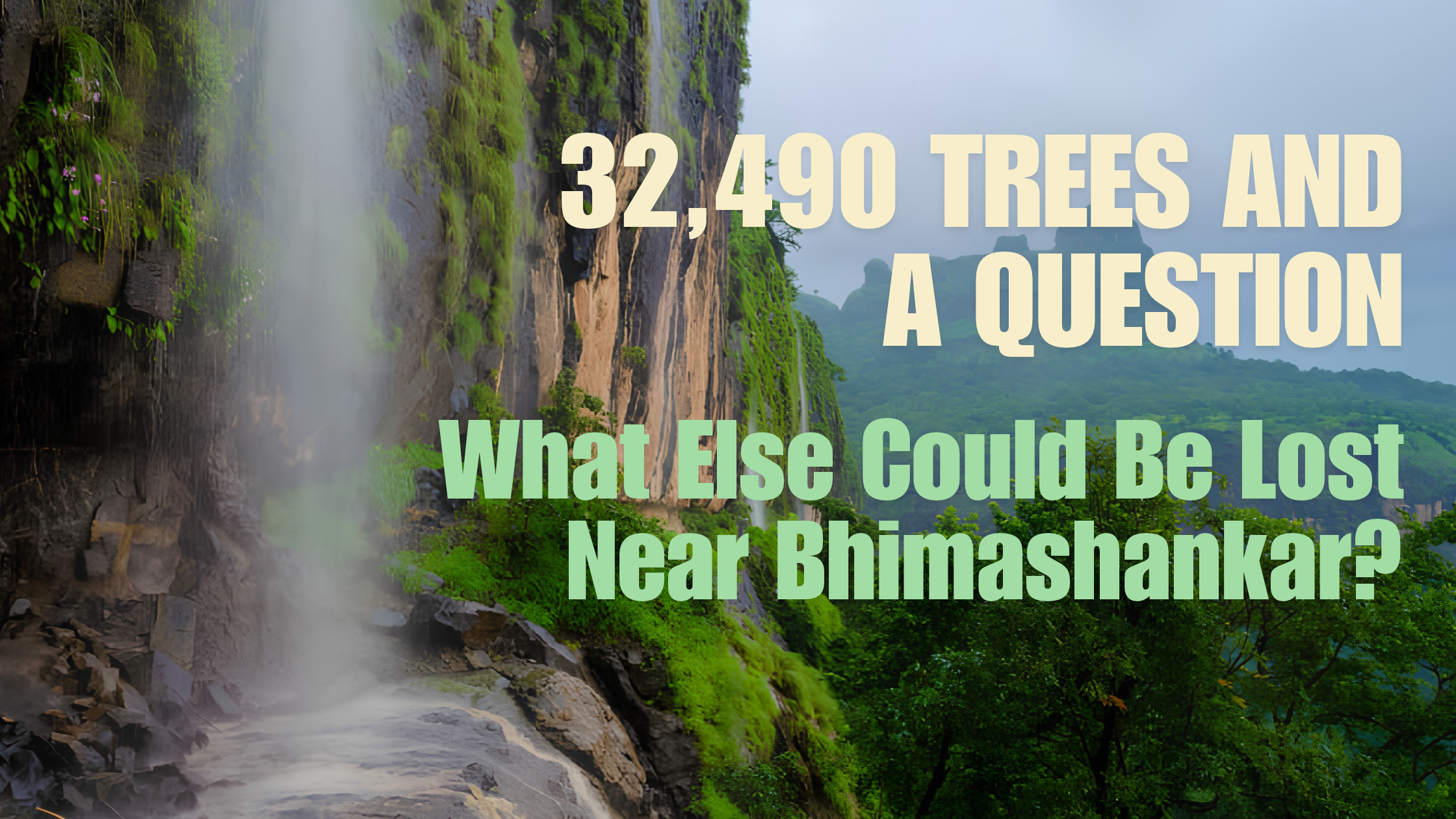
Thirty-two thousand trees make a number. A forest is a home, a water source and a road for animals that have never seen the sanctuary map.
Forest officials have reportedly ordered the felling of 32,490 trees for the ₹13,505-crore Karjat Pumped Storage Hydroelectric Project. The trees stand across approximately 233 hectares of forest land. Torrent Power says the project lies outside Bhimashankar Wildlife Sanctuary, while environmentalists warn of habitat loss and fragmentation. The Forest Department has denied any illegal felling inside the sanctuary itself. So the real argument is about what lies beyond the sanctuary boundary. Read the report on the tree-felling order.
What does a forest provide that a tree count cannot measure?
Bhimashankar’s ecological value extends far beyond its tree cover. The Indian giant squirrel, locally known as Shekru, is native to this habitat. Shekru is Maharashtra’s state animal.
A 2017 botanical study of the sanctuary recorded 1,094 wild plant taxa, including 217 taxa endemic to India. Its forests also provide habitat for Indian giant squirrels, leopards and numerous other animals.
The forest identified for the Karjat project has its own wildlife. According to the project’s draft Environmental Impact Assessment (EIA), animals reported from the study area include leopards, sloth bears, jungle cats, Indian pangolins, sambar deer and four-horned antelopes. Birds such as black eagles, ospreys and shikras, along with reptiles including Indian pythons and Bengal monitors, have also been recorded.
These are species documented in the project’s wider study area, rather than proof that every animal occupies the exact land marked for clearing. Still, the findings establish that the surrounding landscape supports a variety of wildlife.
Lush green trees provide nesting sites and shelter for birds, reptiles, insects and other wildlife. Some of the plants have medicinal uses. The dense, sheltered canopies allow giant squirrels to move between trees. Shekru spends much of its life in the treetops, feeding, nesting and travelling along branches. Gaps in the canopy can make that movement more difficult, affecting access to food and suitable nesting sites.
Dried leaves on the ground support soil organisms, while tree roots help stabilise slopes, slowing runoff and reducing soil erosion.
Forests in this landscape also play an important role in groundwater recharge and protecting streams from siltation. Removing established trees and vegetation can affect the overall habitat, water systems and surrounding plants.
These ecological relationships take years to develop. Counting trees alone cannot tell us how much a forest supports.
Can cutting trees in one area affect wildlife in other places?
Think of forests as a large community; now imagine that community being fragmented. This can separate animal populations and make movement between habitats more difficult. Some species may become isolated, limiting opportunities for breeding and reducing access to familiar food sources.
Corridors are the strips of habitat that keep forest patches connected. For animals that move across large territories or depend on continuous tree cover, these connections can be essential.
There is debate about whether this project threatens important wildlife connectivity in the region. Environmentalists have raised concerns about fragmentation in the Western Ghats landscape around Bhimashankar. Torrent Power says the project is about 16 km from the sanctuary and that all its components are outside the sanctuary and its eco-sensitive zone.
Interestingly, the project’s own draft environmental assessment acknowledges that clearing forest vegetation will disturb wildlife habitats. It identifies tree cutting, construction activity and increased human interference as potential environmental impacts. It also notes that dust from blasting and vehicle movement could affect vegetation up to 500 metres from its source.
The assessment describes proposed mitigation measures, including planting native species, controlling construction-related disturbance and implementing a wildlife conservation plan.
Torrent Power has maintained that the project underwent environmental assessments, public hearings and expert appraisal. The company says its measures include a wildlife conservation plan, catchment-area treatment and long-term habitat management.
But wildlife does not recognise sanctuary boundaries. An animal moving between forest patches cannot distinguish a protected area from the surrounding landscape.
Being outside a sanctuary does not automatically mean that a project will have no impact on nearby ecosystems. The assessment acknowledges habitat disturbance, but the publicly available executive summary does not establish whether a specific wildlife corridor crosses the land to be cleared.
That leaves an important question: how will the existing movement routes of animals in the affected landscape be identified and protected?
Can planting new trees really replace an old, established forest?
Compensatory afforestation can restore tree cover, but it takes a long time. Freshly planted saplings are very different from a mature forest. It can take decades for a new forest to grow and develop the ecological characteristics of an established one.
The kinds of trees planted and their location determine how much of the forest’s ecological value can really be restored.
- A mix of native fruit trees and canopy trees helps support wildlife. If only one fast-growing species is planted, it may add greenery without providing the same variety of habitats.
- If new trees are planted far from where the forest was cut down, they may do little to help the animals and watersheds that lost their habitat.
- Saplings matter only if they survive, so someone needs to monitor them for years.
For this project, Torrent Power says it plans to plant approximately 90,000 trees. This includes 60,000 trees in project-related areas and another 30,000 on compensatory afforestation land. The company also says it has provided 253 hectares of land, already containing approximately 70,000 trees, to the Forest Department. These measures were detailed in the company’s statement.
The project’s draft environmental assessment provides a budget of approximately ₹34.83 crore for compensatory afforestation, including saplings, labour, irrigation and five years of maintenance. It also outlines a separate biodiversity and wildlife conservation plan.
It’s important to ask where the new trees will be planted, what species will be chosen and who will check if they survive. There is also the question of whether the replacement vegetation will restore the connections between wildlife habitats.
The Karjat project is intended to support electricity storage and grid stability as India expands its renewable energy capacity. Those benefits are part of the development argument. But they do not eliminate the need to understand what the surrounding forest may lose.
If we think of a forest as just a collection of trees, we might forget about all the life that depends on it.
The 32,490 trees marked for removal can be counted. The habitats they support, the animals that move between them and the ecological relationships built over decades are much harder to measure. And once those connections are disturbed, planting new trees may not be enough to bring them back.