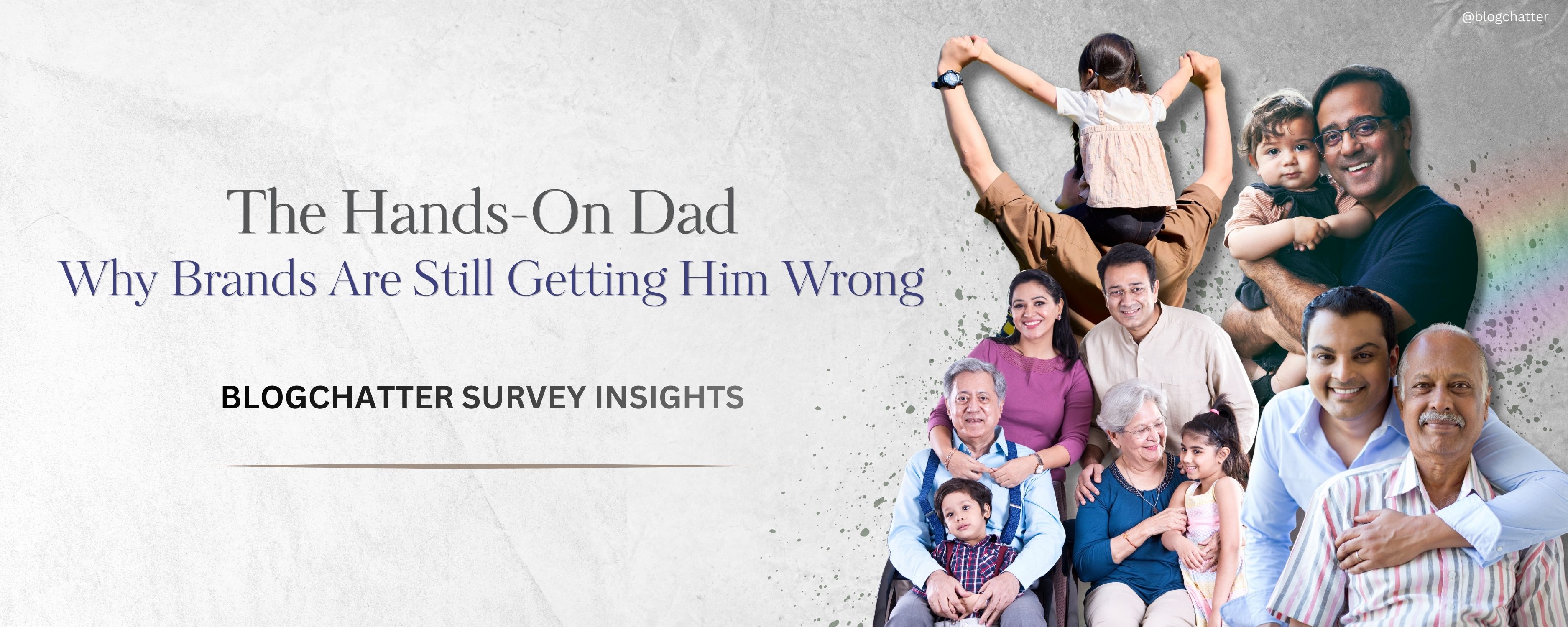
Indian fathers are no longer sitting at the edge of family life. A Blogchatter survey of Indian fathers paints a striking portrait: more involved than ever, yet largely unrecognised by families and brands alike. Here is what the data reveals, and why it matters for marketers. The gap is obvious. Fathers are present in parenting, shopping, finance, health decisions, and household planning, but Father’s Day campaigns still treat them like distant providers.
Key findings from the survey
|
What the survey found |
Why it matters for brands |
|
84% of fathers feel more involved than their own fathers |
Fatherhood has shifted from providing only to active parenting |
|
71% call themselves parenting partners |
Campaigns must show fathers in everyday parenting |
|
Only 16% feel brands depict fathers realistically |
There is a clear representation gap |
|
79% personally do grocery shopping |
Fathers influence household purchase decisions |
|
70% want time and experiences on Father’s Day |
Gifting campaigns should focus less on products and more on shared moments |
The modern dad is not who ads think he is
The traditional image of the distant provider is badly out of date. Today's father does the grocery run (57%), sits at the table for mealtimes (48%), drops kids off at school (34%), and spends at least 2 to 3 hours a day actively with his children on a regular weekday.
Yet 36% feel fathers are less appreciated than mothers and only 16% believe brands depict them realistically.
This gap between lived experience and public representation is the most powerful creative tension brands can tap into this Father's Day.
Health: The sacrifice nobody talks about
Most fathers self-report decent health but scratch the surface and the trade-offs become clear. One in five says he often sacrifices his own health needs to prioritise the family. Routine check-ups, supplements, gym memberships, these are the first things cut when the household budget tightens.
-
68% actively try to eat healthy
-
55% exercise or play a sport
-
48% monitor blood pressure or sugar
-
21% sacrifice their own health for family
Nutrition: Dad's at the shelf, not just the table
While mothers are still the primary decision-makers on what gets cooked, fathers are very active at the point of purchase. Nearly 79% personally do the grocery shopping, 52% choose healthier alternatives, and 55% actively limit junk food for the family. When buying for children specifically, 82% rank nutrition and health benefits as their top priority above taste, price, or even brand.
Finance: Confident planner, quietly stretched
Financial ownership in this group is high; 91% have a savings account, 67% hold mutual funds or SIPs, 66% have life insurance. Most are actively involved: 54% handle financial planning jointly and 61% invest regularly for long-term goals. But nearly a quarter also feel financially stressed, and 21% say they mostly live month to month. Confidence and pressure coexist in the same household.
Tech & durables: The family's unofficial CTO
When a new appliance or gadget enters the home, dad is almost always in the decision loop — 45% say it is mainly their call, 39% say it is joint. Crucially, the top buying criteria are not personal preferences; they are brand trust (71%), price-value (71%), after-sales service (55%) and energy efficiency (45%). These are choices being made for the household, not for the individual.
What fathers actually want on Father's Day
This may be the most important finding for any brand planning a Father's Day campaign: 70% of fathers want time and experiences together, 50% value handmade gifts or cards, and 48% like a surprise planned by family. Only around 11% actively want personal care, health products or financial gifts. The gift economy around Father's Day is fundamentally about presence, not products.
Opportunities for brands to shine this Father’s Day
-
For health and wellness brands
Preventive care should not be framed as vanity. The survey shows that 21% of fathers sacrifice their own health for the family. A stronger Father’s Day message would position check-ups, diagnostics, or health plans as a way of helping dads stay present for longer. -
For FMCG and nutrition brands
The survey shows that fathers are active at the point of purchase. They are comparing healthier alternatives, limiting junk food, and prioritising nutrition for children. Campaigns that show only mothers making these choices miss a real shopper. -
For finance brands
A SIP, term plan, or child savings plan can be framed as a practical form of care. The data shows that fathers are confident planners, but also financially stretched. Communication should acknowledge both pride and pressure. -
For tech and durable brands
The dad buying a washing machine, water purifier, phone, or appliance is often thinking about safety, service, value, and energy efficiency. That is a better emotional route than showing him as a gadget-obsessed man buying toys for himself.
Fathers are already doing the work at the shelf, in the kitchen, at school drop-off, and on the weekend. The brand that chooses to acknowledge that, build around it, and help make it easier will earn something most Father's Day campaigns never do: genuine relevance.