

The Series B Trap: Why Fast-Growing Startups Outgrow Their Tools Before Their Teams
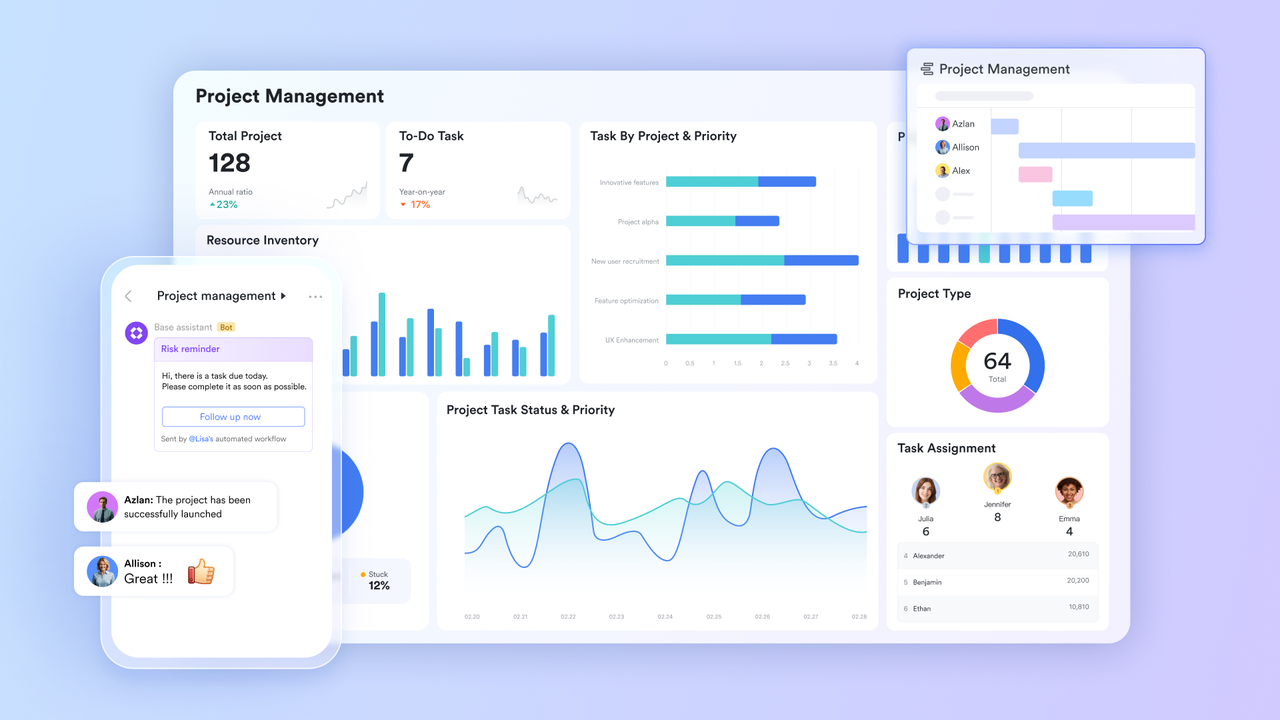
There is a well-documented pattern in startup growth: a company raises a significant round, doubles its headcount in twelve months, and then discovers that the tools which made it fast at twenty people are actively slowing it down at sixty. The chat tool that worked fine with a close-knit founding team is now a firehose of irrelevant notifications. The shared spreadsheet that tracked all the leads is now a source of conflicting data. The wiki that held the company’s processes is now an unmaintained archive that nobody trusts. This is the Series B trap — not a funding problem, not a hiring problem, but an infrastructure problem that arrives precisely when the company can least afford to be distracted by it. The companies that avoid it are the ones that build their operational foundation on project management tools designed to grow with them rather than around them.
Keeping communication structured as the team multiplies with Lark Messenger
- “Chat Tabs & Threads” for in-group organization. As team size increases, the volume of messages in any given group grows proportionally. Lark Messenger lets teams pin structured reference content — briefs, decision logs, FAQs — directly into tabs within a group chat, and keeps topic-specific conversations in threads rather than the main feed. New team members joining a group immediately see the most important context at the top rather than scrolling through hundreds of messages to find it.
- “Real-time Auto Translation” across 18 languages. Fast-growing startups that expand internationally often build multi-language teams faster than they build translation infrastructure. Lark Messenger translates every message into the reader’s preferred language in real time, so a team member in Jakarta and a team member in Berlin can communicate in their native languages without either losing meaning or speed.
- Group folder organization with custom notification rules. As the number of active groups grows from ten to fifty to a hundred, Lark Messenger allows teams to organize groups into labeled folders — Active Projects, Departments, External Partners — and set different notification rules for each folder. A founder can stay informed on every active project without being interrupted by every casual message in every internal social channel.
Keeping the product and sales data clean at volume with Lark Base
- Replacing fragile spreadsheets with structured data management. As startups scale, shared spreadsheets become difficult to manage—simultaneous edits create conflicts, permissions are limited, and sensitive data can be exposed. Lark Base provides a structured database environment with access controls, helping teams manage growing datasets more reliably and securely.
- Automating workflows across teams. Lark Base allows teams to set up triggers based on status changes. For example, when a sales record moves from “Proposal Sent” to “Contract Signed,” it can automatically notify finance, create onboarding records for customer success, and update tracking systems. This reduces manual coordination and helps processes scale without adding operational overhead.
- Multiple views for different team needs. The same dataset in Lark Base can be viewed in different formats depending on the team’s needs. Sales teams can use a Kanban view by deal stage, finance teams can analyze data in grid format with formulas, and leadership can monitor performance through dashboards. This ensures all teams work from consistent, up-to-date information without creating duplicate reports.
Making it easy for new hires to find what they need with Lark Wiki
- Structured onboarding spaces. Lark Wiki allows HR and department leads to build dedicated onboarding spaces for each role or team, with nested pages covering everything from company values to tool access to team-specific processes. A new sales hire can work through their onboarding documentation independently without requiring a senior team member to sit alongside them for two days.
- “Advanced Search” with powerful filters. As the Wiki grows from fifty pages to five hundred, the ability to find the right document quickly becomes critical. Lark Wiki’s “Advanced Search” lets team members filter by creator, date, space, and content type, so locating a specific process document or a historical decision record takes seconds rather than minutes of manual browsing.
- Linked documents from Docs and Sheets. Lark Docs and Sheets documents can be embedded or linked directly within Wiki pages, so the knowledge base doesn’t become a dead archive of printed-out snapshots. A process page in the Wiki can link to the live operational template in doc, ensuring that anyone who reads the process is one click away from the actual working version.
Giving the leadership team real-time visibility without extra reporting work with Lark Slides
- Reducing manual effort in recurring reporting. At Series B, board reports and leadership updates become a recurring operational task that requires collecting data, building slides, and formatting content. Lark Slides helps reduce this burden by keeping presentation materials aligned with the underlying data, minimizing repetitive manual work.
- Keeping charts up to date with live data. Charts in Lark Slides can be linked to Lark Sheets data sources, allowing presentations to reflect the latest numbers without rebuilding slides each time. This shifts the focus from assembling data to analyzing insights and shaping the narrative.
- Enabling real-time collaboration on presentations. Multiple stakeholders can work on the same deck simultaneously—finance, product, and leadership—without managing multiple file versions. This streamlines the review process and allows teams to produce complete, aligned presentations more efficiently.
Capturing decisions before they disappear with Lark Docs
- “Comment” and thread resolution for structured review. Lark Docs allows reviewers to leave comments on specific paragraphs, sentences, or elements within a document, and the document owner can mark each comment as resolved once it has been addressed. As the team grows and more stakeholders are involved in every decision, this threaded review system keeps the feedback process organized and ensures that every point raised is either actioned or explicitly dismissed.
- “Version History” for full edit transparency. Every change made to a Lark Docs is logged with a timestamp and the name of the editor. For a fast-growing company where processes and decisions evolve rapidly, this means any team member can see exactly how a document has changed over time and understand the reasoning behind current policies by tracing the evolution of earlier drafts.
- Document templates for consistent team output. Teams can build and share standardized templates within Lark Docs so that every project brief, meeting agenda, or post-mortem follows the same structure regardless of who writes it. As the team grows and new hires start producing documents, the quality and consistency of the output doesn’t depend on institutional knowledge being transferred manually.
Making sure every process request gets properly handled with Lark Forms
- Multi-step form logic for complex requests. Lark Forms supports conditional branching so that the fields a submitter sees change based on their previous answers. A vendor onboarding form can show procurement-specific fields when the submitter selects “new supplier” and a different set of fields when they select “renewal.” The same form handles multiple scenarios without requiring separate forms for each case.
- Direct mapping to Base for zero-latency processing. Every field in a Lark Form can be mapped to a specific column in a Lark Base table, so submissions arrive as structured database records rather than unstructured messages. The operations team processes the request from within their existing Base workflow rather than reading an email and manually entering the data elsewhere.
- Shareable via link with no account required. External parties, including vendors, applicants, and clients, can submit forms via a shared link without creating a Lark account. The intake process works for anyone the company needs to collect information from, not just the team members who are already on the platform.
Bonus: What the most successful Series B companies do differently
When fast-growing companies assess their tooling at this stage, the comparison almost always starts with familiar names. Teams look at Google Workspace pricing as the baseline, then evaluate whether specialist tools like Notion, Asana, Salesforce CRM, and Tableau provide enough lift over the baseline to justify the additional cost and complexity.
What the most operationally efficient companies discover is that the cost of connecting those specialist tools to each other often exceeds the cost of the tools themselves, measured in engineer time, integration maintenance, and the ongoing manual work of keeping data synchronized across systems that were never designed to share it. The companies that grow cleanest are the ones that recognized early that operational speed comes from information flowing without friction, and that friction is most often created by the gaps between tools rather than by any individual tool’s limitations.
Lark removes those gaps by design. The data in Base is accessible to Sheets. The record in Sheets drives the chart in Slides. The form submission lands in Base and triggers an approval in Approval. The approved outcome reaches the team in Messenger. Each step feeds the next without a human in between.
Conclusion
The Series B trap is not inevitable. It is the predictable result of building operational habits on tools that scale poorly, and it can be avoided by making infrastructure decisions before growth makes them urgent rather than after growth makes them painful. A platform that keeps communication, data, knowledge, and processes unified from the start grows stronger as the team grows larger. When you build on a connected set of productivity tools that expands with your complexity instead of buckling under it, the infrastructure becomes your competitive advantage rather than your constraint.