
Sabari Before Rama: The Story On the Banks of the Pampa Brings to the Centre
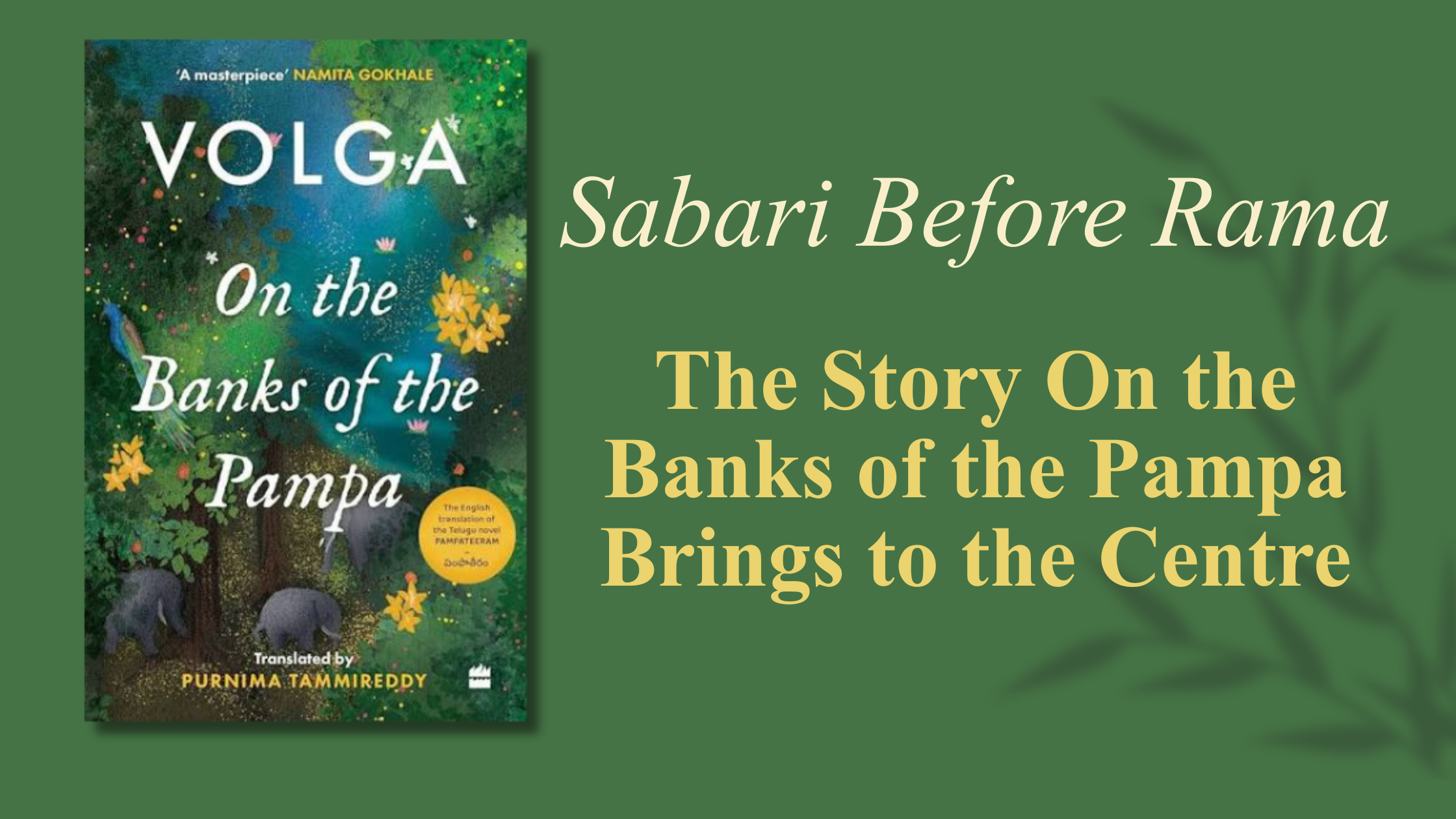
Most people encounter Sabari through her meeting with Rama. On the Banks of the Pampa changes the point of view by placing Sabari’s own life at the centre. Written by Volga, translated from Telugu by Purnima Tammireddy and published by HarperCollins India in 2025, the novel returns to a familiar epic character and asks what becomes visible when someone usually remembered through another person’s story gets one of her own.
Sabari is one of those characters many readers recognise even if they have never thought much about her life before Rama entered it. Popular retellings of the Ramayana have made her devotion to him one of the most familiar parts of her story.
On the Banks of the Pampa begins elsewhere.
Who is Sabari beyond her meeting with Rama?
Sabari is introduced as a child of the aranyavasis, or forest dwellers, who is enslaved by a colonising state, escapes captivity and reunites with her guru, Matanga Muni. Her life unfolds in the forest along the Pampa river before the encounter with Rama becomes part of it.
Moving Sabari to the centre changes the questions available to the reader. Instead of asking only what she contributes to Rama’s journey, there is room to ask where she came from, what shaped her beliefs and what her world looked like before he arrived.
That is one of the possibilities literary retellings offer. A character remembered through a single scene can be given history, relationships, conflict and a point of view of her own.
What changes when a marginal character becomes the centre?
Changing the central character can also change the scale of a familiar story.
Usawa Literary Review reads On the Banks of the Pampa through questions of kingship, civilisation, power and the treatment of marginalised communities.
The tension between the forest and an externally imposed idea of civilisation is also visible. Forest dwellers are asked to cut trees, flatten land, build houses and adopt agriculture while the authority proposing this version of progress also decides how the land will be distributed.
A Sabari-centred narrative can therefore move beyond the familiar idea of devotion. It opens questions about who defines civilisation, whose relationship with land is considered legitimate and what happens when people at the edges of an epic begin describing the world from where they stand.
Where does Sabari fit into Volga’s writing?
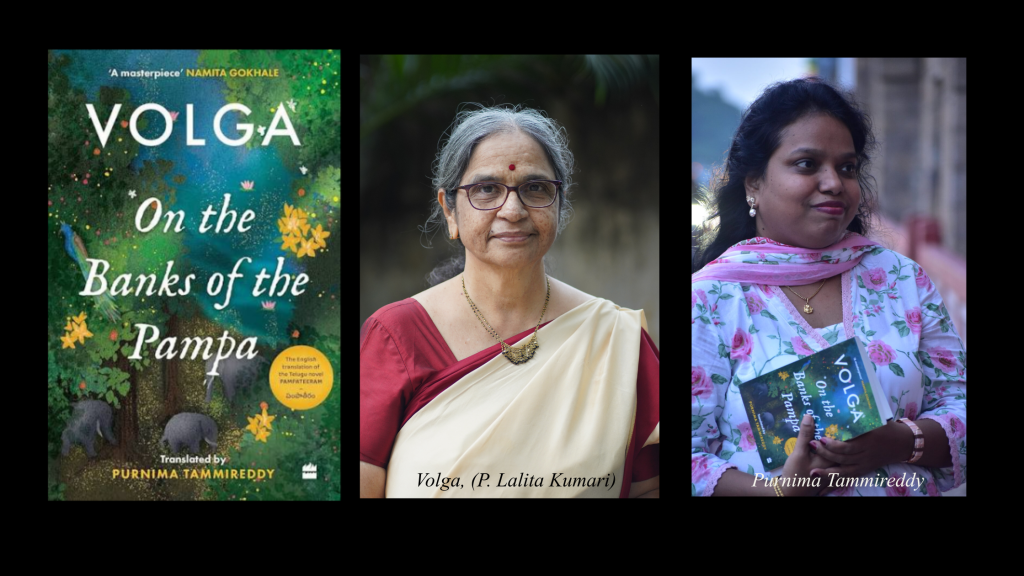
Volga is the pen name of P. Lalita Kumari, an important voice in Telugu literature whose work has frequently engaged with women’s lives, autonomy and social structures.
Her writing includes Sveccha, Rajakiya Kathalu and Vimukta. Volga received the 2015 Sahitya Akademi Award in Telugu for Vimukta, a collection of short stories. The Sahitya Akademi’s official record confirms the recognition.
English-language readers may also know her through The Liberation of Sita. On the Banks of the Pampa is the final volume in Volga’s trilogy of feminist retellings of the epics.
Sabari therefore fits into a longer body of work interested in women who have often existed at the edges of familiar narratives.
How does Purnima Tammireddy translate Sabari’s world?
Translation adds another layer to a retelling because the story must move between languages without losing the vocabulary of the world it comes from.
Purnima Tammireddy is a writer, translator and publisher working in Telugu and English. She has translated works by Manto and Amrita Pritam into Telugu, founded Elami Publications and co-founded the book-review platform pustakam.net.
In an interview with Usawa Literary Review, Tammireddy discusses the decision to retain selected Telugu words rather than replacing every culturally rooted term with an English equivalent. She uses nagarikata as one example of a word whose meaning shifts across Indian languages.
That choice becomes particularly relevant in a story concerned with ideas such as civilisation, knowledge and belonging.
About the author
Volga, the pen name of P. Lalita Kumari, is a Telugu writer, critic, poet and translator. Her work spans novels, short stories, poetry and feminist writing. She received the 2015 Sahitya Akademi Award in Telugu for Vimukta.
About the translator
Purnima Tammireddy is a writer, translator and publisher working in Telugu and English. Her translations include works by Manto and Amrita Pritam. She is the founder of Elami Publications and co-founder of pustakam.net.
Read On the Banks of the Pampa with us
On the Banks of the Pampa is one of the 12 titles on our Blogchatter Book List 2026 Longlist.
To encourage you to explore the Longlist, we’re also hosting a lucky draw for readers who complete their reading goals.
- Read 1–5 books: 5 lucky winners will receive 300 Reward Points each
- Read 6–12 books: 5 lucky winners will receive 500 Reward Points each
To be eligible, you must leave your review on the book’s listing on the Blogchatter website.
You’re welcome to create additional content around your reading, including blogs, reels, Stories or social posts, but that is not required for the lucky draw.
Later this month, we’ll share details on the voting process, where everyone can vote for their favourite title or titles from the Longlist.
Pick your books, start reading, and remember to leave your reviews on Blogchatter.
You have until 30 November to read and review the Longlist. Voting for the Shortlist opens in the first week of December.
Note: When the JCB Prize for Literature longlist was discontinued, we introduced the Blogchatter Book List in 2025 as our own reader-led initiative built around community recommendations, reading, reviews and voting.