
Why Ordinary Places Make Such Good Mystery Settings: The Girl in the Coffee House
A coffee house hardly looks like the beginning of a mystery. People come in for coffee, meet friends, open their laptops or sit alone for an hour. Yet that ordinariness can make it a surprisingly effective setting for suspense. Strangers share the same room without really knowing one another, conversations happen within earshot and regular customers slowly become familiar faces.
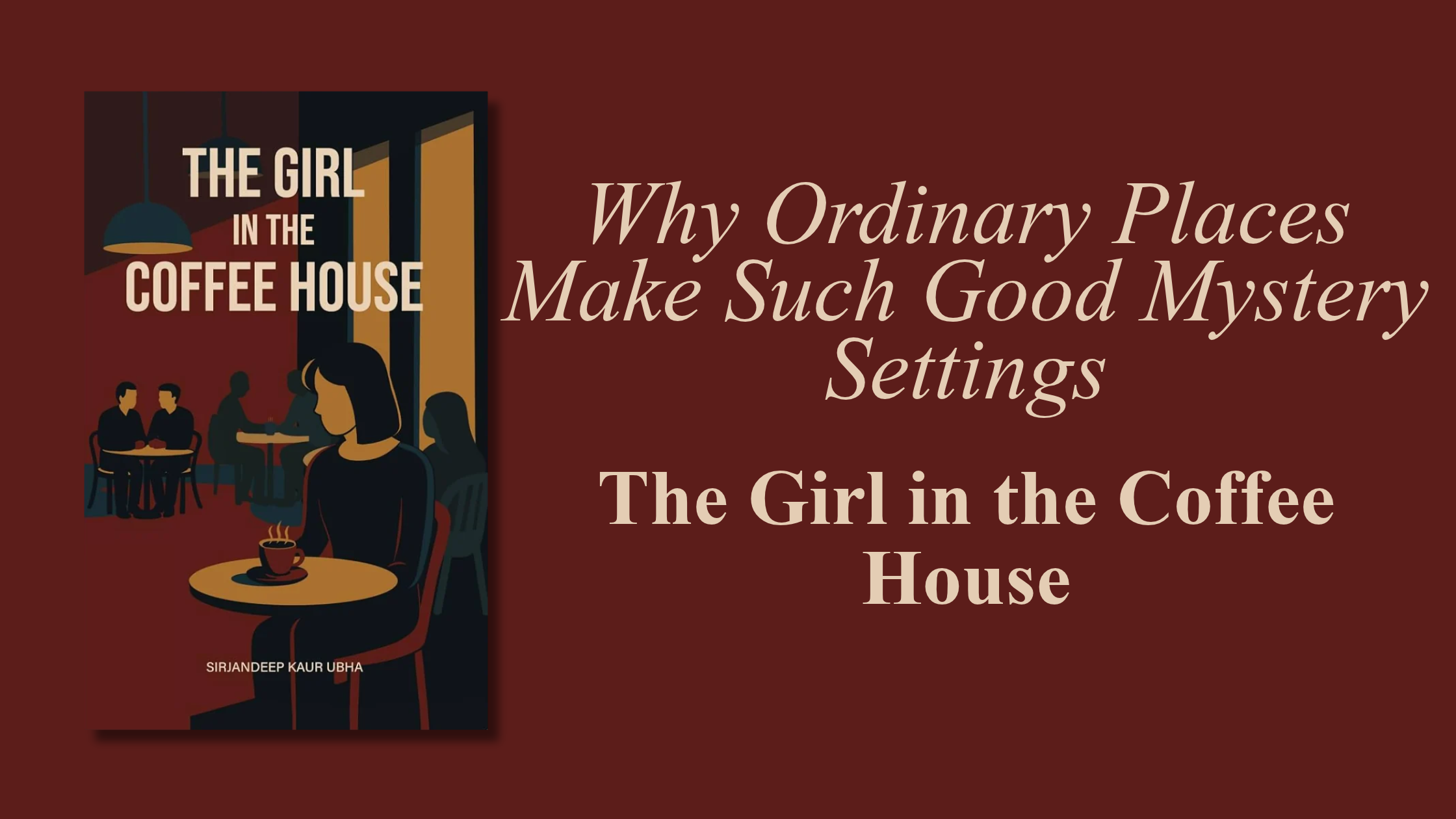
Sirjandeep Kaur Ubha uses this everyday setting in The Girl in the Coffee House, a mystery thriller published by Anecdote Publishing House in 2025. Riya comes to Delhi hoping for a fresh start, but a quiet coffee house, two brothers and a stranger draw her into a web of half-truths and buried secrets. As familiar faces begin to disappear, her new life starts connecting with things left unresolved in the past.

Why do ordinary places work so well in mysteries?
Mysteries do not always need isolated mansions, abandoned buildings or obviously dangerous places. An everyday setting can create its own tension because nothing initially looks suspicious.
A coffee house is ideal for this. People arrive alone and sit beside strangers. Staff recognise regular customers, but may know little about their lives. Someone can return to the same table every week and still remain almost completely unknown.
That gap between recognition and actual knowledge gives a mystery writer plenty to work with.
In The Girl in the Coffee House, Riya’s routine gradually becomes less predictable. The space that initially offers familiarity begins to raise questions about the people around her and what they may be hiding.
How well do we know the strangers we see every day?
Most of us have familiar strangers in our lives.
It could be someone who takes the same train every morning, a neighbour we regularly pass in the lift or the person who seems to occupy the same café table every weekend. We recognise them, but recognition can easily create an illusion of knowing someone.
Mystery fiction can use that uncertainty well. A familiar face may have a history no one around them knows. A casual meeting may not be accidental. A conversation that means little at first may look completely different once another detail appears.
Ubha builds on this through Riya’s encounters with two brothers and a stranger in Delhi. The mystery widens as people around her begin to connect in unexpected ways, bringing family relationships and older secrets into the present.
The tension comes from not knowing where familiarity ends and secrecy begins.
Why are coffee houses good places for observation?
There is something unusual about being alone in a crowded café. You can sit among dozens of people without being part of any of their conversations.
Instead, you notice fragments.
Someone always arrives at the same time. A regular customer suddenly stops coming. Two people who usually meet no longer appear together. Someone leaves abruptly after a conversation.
In everyday life, most of these details mean nothing. In a mystery, one small observation can later become important.
That makes the coffee house a natural setting for a character who notices people. It allows suspense to develop inside an ordinary urban routine rather than transporting the story into an obviously threatening world.
The setting works because the danger, if there is any, is hidden inside something familiar.
What happens when a fresh start meets an unfinished past?
Moving to a new city often carries the promise of beginning again.
For Riya, Delhi offers that possibility. But The Girl in the Coffee House gradually connects her present to buried family secrets and relationships that have not disappeared simply because time has passed.
That is a familiar tension in mystery fiction for a reason. Changing your surroundings does not erase old choices, relationships or unanswered questions.
The coffee house becomes the point where Riya’s new life begins to overlap with an older one. New people enter her world while truths connected to the past start returning with them.
The mystery is therefore not only about what is happening around her now. It is also about how much of the past can remain hidden before it begins shaping the present again.
Sirjandeep Kaur Ubha’s journey from poetry to mystery fiction
Sirjandeep Kaur Ubha comes from a family of writers in Punjab and holds a master’s degree in Human Resources and Organisational Behaviour from the London School of Economics.
Her writing has moved across poetry and fiction. She published Whispers of the Heart while still in school, followed by The Triumph and To Skies and Waters. The latter was among the books recommended for the Sahitya Akademi Yuva Puraskar 2022 in English.
The Girl in the Coffee House is her fourth book and takes her writing into mystery fiction. The choice of an ordinary public space as its central setting gives the story room to work with observation, anonymity and relationships that are not quite what they first appear to be.
Read The Girl in the Coffee House with us
The Girl in the Coffee House is one of the 12 titles on our Blogchatter Book List 2026 Longlist.
From the many books recommended by readers, authors and publishers, 12 made the Longlist. If you pick this one, leave your review on its book listing on the Blogchatter website once you finish reading.
We’re also hosting a lucky draw for readers exploring the Longlist:
Read 1–5 books: 5 winners receive 300 Reward Points each
Read 6–12 books: 5 winners receive 500 Reward Points each
A review on the book’s Blogchatter listing is required for eligibility. Blogs, reels, Stories and other content are welcome, but optional.
You have until 30 November to read and review. More details about voting will be shared towards the end of the month.
About the author
Sirjandeep Kaur Ubha is a writer from Punjab whose work spans poetry and fiction. She holds a master’s degree in Human Resources and Organisational Behaviour from the London School of Economics. Her books include Whispers of the Heart, The Triumph, To Skies and Waters and The Girl in the Coffee House.
Note: We introduced the Blogchatter Book List in 2025 when the JCB Prize for Literature was discontinued. The Blogchatter Book List is our own reader-led initiative built around community recommendations, reading, reviews and voting.